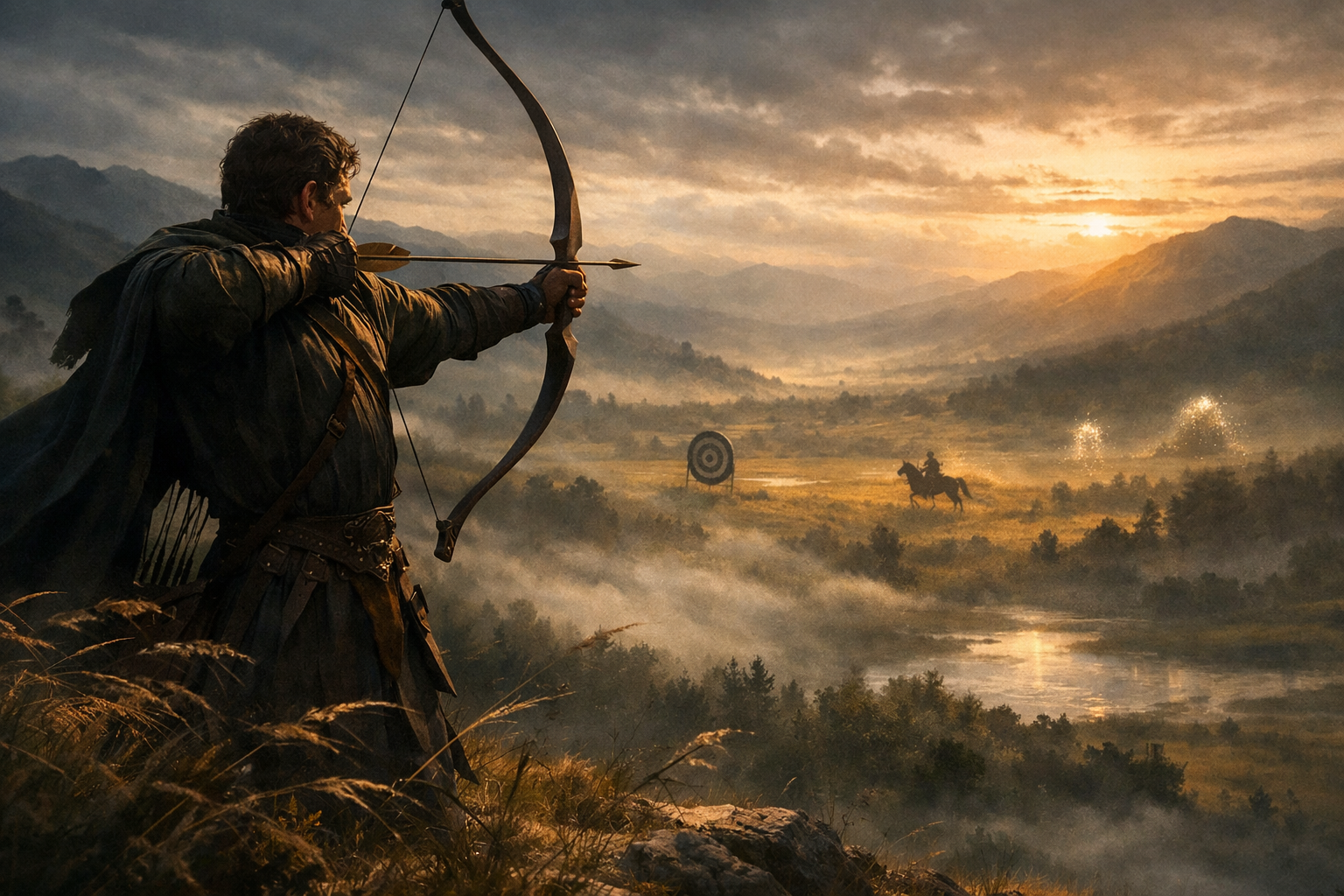
There is an archer standing alone on a hill overlooking a vast valley. He is not hurried. He is not restless. He is simply present, bow in hand, arrows at his back. Across the valley stand various targets. Some are still. Some drift slowly. Some flash and move in ways that make them look urgent and irresistible. From a distance, it is hard to tell which ones are real and which ones are illusions painted to lure the impulsive.
The archer does not shoot immediately.
He feels the wind first.
The wind brushes his cheek, presses lightly against his chest, shifts subtly across the grass at his feet. He knows something most people forget: timing is not about speed. It is about alignment with forces already in motion. If he releases into a strong headwind, even a perfectly aimed arrow will drift off course. If he waits for a lull or a supportive current, the same arrow will travel twice as true with half the effort.
In life, the wind is everywhere. It is the emotional climate of a room before you speak. It is your nervous system state before you send a message. It is the market cycle before you invest. It is the unspoken tension in a relationship before you escalate. Most people fire anyway. They act to relieve inner pressure. They mistake urgency for opportunity.
The disciplined archer stands longer than is comfortable. He lets impatience rise and fall. He does not confuse internal agitation with external readiness. When the wind shifts — when resistance softens — he knows it without drama.
That is the beginning of great timing.
Drawing the Bow Without Releasing
When he does draw the bow, he does not release immediately. The string tightens. Muscles engage. The arrow is loaded with potential energy. But he holds.
This is where most people fail. They cannot tolerate drawn tension. They speak too early in conversation. They push too quickly in romance. They exit trades too fast. They apologize prematurely. They fill silence. They discharge energy the moment it builds.
But power accumulates in the hold.
Holding is not hesitation. It is containment. It is the ability to remain composed while energy gathers inside you. In chess, players like Magnus Carlsen are known for this quality. He does not rush exchanges simply because they are available. He squeezes positions patiently, waiting for the smallest imbalance to appear. He can tolerate long stretches of tension without forcing resolution.
The archer on the hill embodies that same discipline. His arms may strain, but his breath remains steady. He waits for the moment when wind, distance, and stillness converge. He is not passive; he is coiled.
Great timing requires a nervous system that can hold power without leaking it.
Illusion Targets in the Valley
Across the valley, some targets are deceptive. They shimmer slightly. They move unpredictably. They almost dare him to act. These are illusion targets — opportunities that look compelling because they stimulate desire or ego.
In life, illusion targets appear as validation disguised as love, urgency disguised as opportunity, chaos disguised as chemistry. They feel dramatic. They feel charged. They whisper, “Now or never.”
But the archer studies their movement. He notices inconsistency. He notices the wind around them is turbulent. Shooting at these targets may satisfy impulse, but it wastes arrows.
True opportunity has a different quality. It stabilizes. It aligns. It becomes quiet and precise rather than loud and frantic. When the right target presents itself, there is less emotional noise and more clarity.
Timing is the discipline of distinguishing drama from alignment.
The Release
When the moment arrives, the release does not feel explosive. It feels simple. His fingers open. The string snaps forward. The arrow leaves cleanly. His body remains calm.
This is another paradox of great timing: when it is right, it feels almost effortless. The action may be bold — a decisive career move, a committed relationship step, a large investment — but internally it does not feel chaotic. It feels synchronized.
Think of a surfer like Kelly Slater catching a wave. From shore, it appears graceful and natural. But that grace rests on years of studying swell patterns, wind direction, and timing entry perfectly. The wave was always coming. The skill lies in entering it at the exact moment it can carry you.
The archer’s arrow travels through air that is now cooperating, not resisting. Effort multiplies because alignment exists.
He does not over-celebrate. He does not collapse in relief. He simply lowers the bow and returns to awareness.
The River
Now imagine the archer setting down his bow and stepping into a river with a narrow kayak. The river represents life’s broader momentum. Some sections are calm and forgiving. Others are fast and dangerous. There are rocks beneath the surface that cannot be seen from above.
If he paddles aggressively against a strong current, exhaustion comes quickly. If he aligns his strokes with the flow, even small movements carry him far downstream.
Great timing in life is often less about muscular force and more about directional intelligence. There are seasons for pushing — when energy is high, when opportunity is abundant. There are seasons for conserving — when tides are shifting, when resistance is structural rather than psychological.
The skilled kayaker does not moralize the river. He does not curse it for flowing the way it does. He studies it. He adjusts his angle. He waits before entering rapids. He commits fully when the line becomes clear.
Timing here is ecological. You are not separate from the current. You are moving within it.
The Blacksmith’s Forge
Shift again. The archer now stands in a forge, hammer in hand, a bar of steel glowing in the fire. Metal cannot be shaped at any temperature. Strike when it is cold and it cracks. Strike when it is too hot and it warps. There is a precise color — a bright orange glow — where the metal is responsive yet stable.
Life has similar temperature windows.
In conflict, strike when emotion is workable, not frozen and not raging. In ambition, act when energy is strong but not reckless. In relationships, escalate when warmth is present but not unstable.
Most people mis-time their blows. They attack too early when resistance is high, or they hesitate until the window has passed. The master blacksmith watches color, not ego.
Timing is sensitivity to heat.
The Hawk Above the Field
Finally, picture a hawk circling high above an open field. It is not flapping frantically. It glides, conserving energy, scanning with precision. For long stretches, nothing happens. From below, it may look inactive.
Then a small movement occurs in the grass.
In an instant, the hawk folds its wings and dives with astonishing speed and accuracy. The action is decisive and brief. Moments later, it rises again into calm air.
Great timing in life resembles this rhythm: extended composure punctuated by sharp, committed action. Not constant agitation. Not endless waiting. Glide. Watch. Conserve. Then strike cleanly when the signal appears.
The archer, the kayaker, the blacksmith, the hawk — they all embody the same principle. They do not confuse movement with progress. They do not act to soothe inner discomfort. They align first, then act.
And when they act, they do so without hesitation.
If you want great timing, train yourself to feel wind before release, to hold tension without discharge, to distinguish illusion from alignment, to sense temperature before striking, and to conserve energy until true movement reveals itself.
Then, when the moment opens — move.
Cleanly. Fully. Without apology.
That is timing.