Introductory Note:
This story is meant to be approached like a quiet walk through a garden at dusk. There are no instructions to “fix” anything, no direct advice, and no rush. Let yourself move through the imagery slowly. If a line resonates, pause there. If a scene draws your attention, linger. The garden and its stars exist for you to explore in your own mind. Grief is not something to conquer—it is a presence to acknowledge, sit with, and, over time, allow to transform.
The Garden of Falling Stars
In a valley cradled by misted mountains, there existed a village that few outsiders noticed. The village itself was ordinary in its walls and streets, but hidden behind a tall stone gate was a secret: a garden that grew not from seeds alone, but from the invisible soil of memory, emotion, and longing.
The gardener who tended this place was named Elara. She had hair like nightfall, hands that had touched every type of earth, and eyes that could see not only what was present but what had once been. The villagers said she spoke to the plants, but it was more than speech—she listened to the murmurs of the soil, to the sighs of the wind, and to the quiet cries of what had been lost.
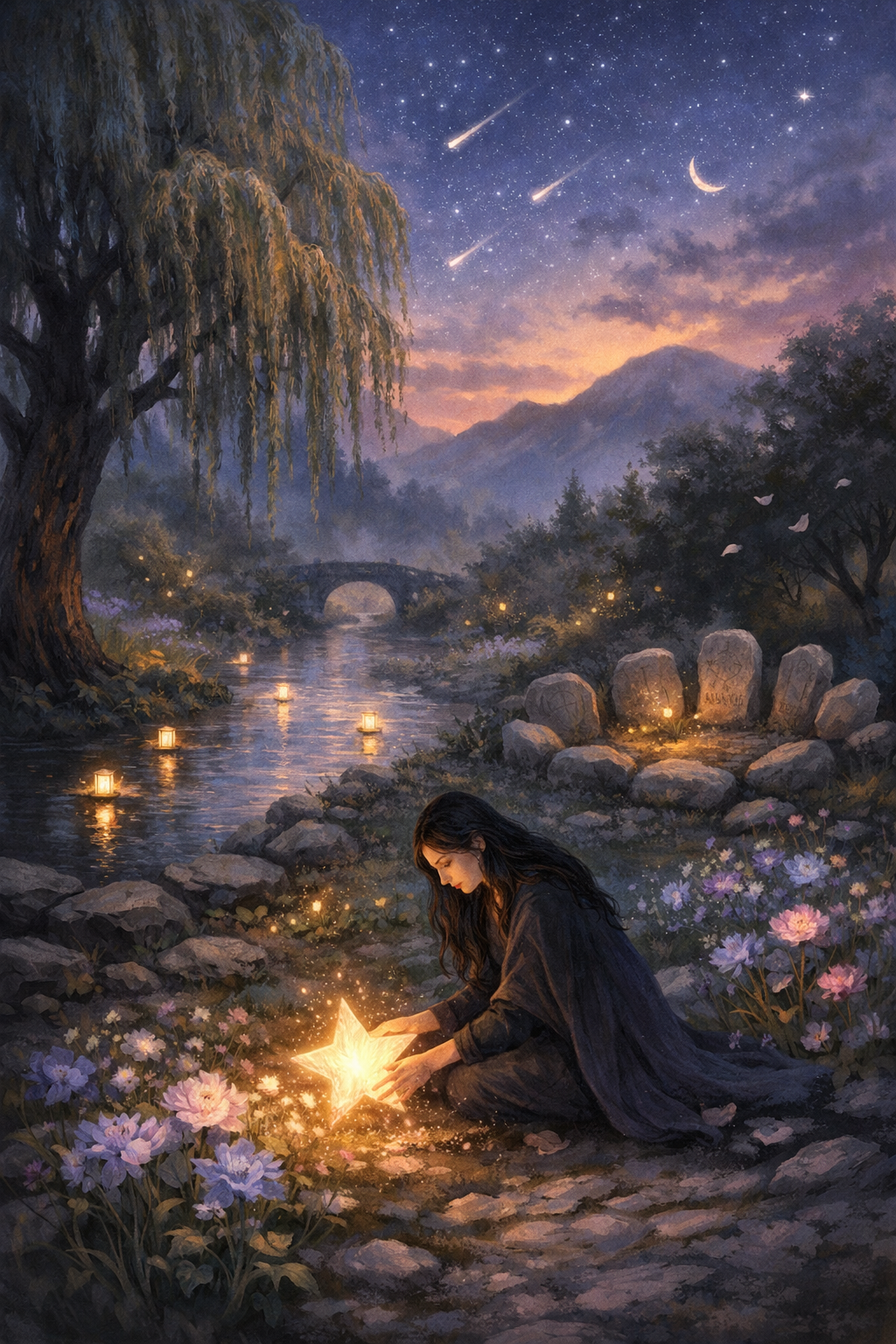
One evening, as the horizon bled gold into purple, a star fell from the sky. Not a blazing comet or a meteor that frightened the night, but a small, trembling light that landed gently among the roots of an ancient willow. The star did not burn. It flickered, as if afraid, as if uncertain of its new home.
Elara knelt beside it, brushing the fragile glow with the tips of her fingers. In that moment, she felt something she had not admitted to herself: grief. She remembered the people she had lost, the dreams that had crumbled, the words she had never spoken. The star seemed to pulse in recognition, vibrating softly in her palm.
Grief, Elara realized, was much like this fallen star. Once it had belonged in the heavens, far from earthly concerns, radiant and free. But when it fell, it landed in the garden of her life. It could no longer shine where it once had, yet it carried a light that could be tended, nourished, and transformed.
For days, she watered it with patience. She whispered stories into its soft glow, stories of laughter, of mistakes, of love and longing. She let it rest in the shadow of the willow, sheltered from harsh winds, and slowly—almost imperceptibly—it began to glow with a richer, warmer light. It did not attempt to return to the sky. It did not plead to burn as it once had. It simply existed, and in doing so, it became part of the garden.
Visitors came quietly, drawn by curiosity or by instinct. They sat near the fallen star and felt something shift within themselves. Memories that had been jagged and sharp softened. Tears could flow without fear. Laughter could emerge uninvited, yet welcome. People began to understand that loss, when witnessed and held gently, could illuminate rather than destroy.
The River of Quiet Sorrows
Beyond the willow, a narrow river wound through the garden. Its waters were silver in moonlight, but those who approached could see reflections of the past: faces, fleeting moments, things and people gone.
Elara taught herself to visit the river every day. She would lower a small lantern into its current, imagining it carrying her sorrow downstream, not to be abandoned, but to be transformed. Stones at the riverbed absorbed the sadness, turning jagged grief into polished strength. Fish, invisible beneath the surface, carried whispers of consolation: small, unseen reminders that life continued to flow.
Occasionally, the river would rise after storms. Waters would flood paths, sweep leaves from the garden, and reveal roots and seeds long buried. At first, Elara feared these floods, fearing the resurgence of old pain. Yet she noticed something miraculous: the river, while turbulent, also washed soil clean, making space for new growth. She learned to trust the river’s rhythm, understanding that grief, like water, could both unsettle and nourish.
The Stones That Remember
At the edge of the garden lay a circle of stones. Each stone was smooth and cold, carved by the passage of time. Some bore faint etchings: symbols, names, or dates that marked significant losses. Others were unmarked, holding memory in silence.
Elara found herself drawn to them when the nights were particularly quiet. She would place her hands upon the stones, feeling the weight of history, the accumulated presence of those who had walked before. The stones did not answer with words; they answered with stillness. In that stillness, she discovered a paradox: to touch grief without being crushed by it, one must surrender to its presence without judgment.
The stones, in their patient memory, taught her resilience. They held what was gone, not as burden, but as foundation. Each time she returned to the stones, grief felt less like a wound and more like a structure—supportive, solid, and enduring.
The Wind That Remembers
There were days when the wind blew fiercely through the garden, carrying leaves and petals in chaotic spirals. The villagers called it the wind of remembrance, for it stirred feelings long buried, unexpected pangs of loss, and sudden flashes of joy.
Elara learned to meet the wind without resistance. She would step into its path, allowing it to tousle her hair, brush against her face, and move her skirts like a wave. The wind was unpredictable, sometimes sharp, sometimes gentle, but it reminded her that grief is not a static thing. It moves. It shifts. It calls attention, sometimes painfully, sometimes tenderly, to what still matters.
Through the wind, Elara understood impermanence and presence. The fallen stars in the garden were not permanent fixtures, nor were her memories. They moved, flickered, and transformed, but their light, though shifting, remained.
The Blossoms of Memory
From the soil enriched by fallen stars, river waters, and the stones’ quiet support, flowers began to bloom. They were unlike ordinary blooms—some glimmered like glass in the sunlight, others were soft as wool, and many carried colors that defied naming.
Elara realized that these blossoms were the alchemy of grief: sorrow transformed into beauty, absence transformed into presence, and remembrance transformed into wisdom. She would pluck a flower, inhaling its scent, and feel a gentle connection to what she had lost. The flower did not erase the pain but allowed it to live differently, as something that could coexist with joy, creativity, and love.
Visitors and the Shared Garden
Over time, more villagers came to the garden, each bringing their own fallen stars. Some came with grief fresh and raw; others carried old wounds they had thought dormant. Elara welcomed each star without distinction. She placed them carefully, allowing them to interact with the soil, water, stones, and wind.
As the garden grew, so did the villagers’ understanding. They began to see that grief, though personal, was also shared. Sitting among the stars, they would sometimes reach out to another visitor, offer a smile, or quietly acknowledge their mutual experience. The garden had become a sanctuary, not of escape, but of recognition: that pain, when held and honored, could become light.
Seasons of the Heart
Years passed. The willow grew taller, the river carved new paths, stones glistened with rain, and fallen stars continued to arrive. Elara aged, as all must, and eventually felt the call to join the stars themselves. Yet she knew the garden would endure.
The villagers continued to tend the stars, to walk the rivers, to sit on the stones, and to feel the wind. They understood that grief does not have a timetable, nor does it demand erasure. It can be held, witnessed, and transformed. They learned that absence can coexist with presence, and loss can coexist with life.
And in this garden, the light of fallen stars never faded. Each star carried the memory of what had been lost, yet illuminated the path forward, guiding anyone willing to enter with patience, presence, and compassion.
A Gentle Invitation
If you are reading this story, you are invited to imagine yourself in this garden. Perhaps a star has fallen for you, trembling and dim. Perhaps a river flows with memories too heavy to carry alone. The stones, the wind, the blossoms—all are there for you.
You do not need to rush. You do not need to judge your grief or try to force it away. Simply notice it, tend it gently in your mind’s garden, and allow it to transform into something that can coexist with light. Over time, the fallen star may glow warmly in the soil of your heart, and you may find that grief, when held tenderly, can teach resilience, compassion, and the quiet power of remembering.