The Village Without Bells
There was once a woman named Elin who lived in a quiet village nestled between low hills and a wide, patient river. It was a beautiful place, but unlike other villages, it had no bells—no church bells to mark the hour, no factory whistles to signal shifts, no school chimes to guide the day. Time, in this village, drifted. People woke when they woke, worked when they felt like it, and rested when the mood took them. Some found freedom in this, but others, like Elin, found themselves slowly unraveling.
Elin had once lived in a city of bells. Her days had been shaped by meetings, commutes, expectations, and rhythms that carried her forward whether she felt ready or not. When she first arrived in the village, she welcomed the quiet. It felt like relief. But over time, something inside her softened too much. Without the bells, her mornings stretched into long, undefined spaces. Her intentions blurred. Tasks became suggestions instead of commitments. She would sit by the window thinking of what she should do—write, clean, walk, prepare a meal—but the day would slip past like water through her hands. Each evening, she felt a quiet disappointment, not sharp or loud, but steady and familiar, as though she had drifted just out of reach of her own life.
The Mapmaker’s Advice
One day, Elin went to visit the village mapmaker, an older woman known for drawing maps that guided not only the feet, but something deeper within a person. Elin hesitated before speaking, unsure how to describe what was wrong, but eventually she said, “I think I’m lost.” The mapmaker looked at her calmly and asked, “Lost where?” Elin paused, then answered, “In my days. I don’t know how to move through them anymore.”
The mapmaker nodded as though this made perfect sense. She explained that in a village without bells, people who wished to feel grounded had to do something different. They had to build their own structure. Not out of obligation or force, but out of intention. She handed Elin a blank piece of parchment and said, “This is your day. It will remain empty unless you choose to mark it. The structure you’re looking for won’t arrive on its own—you’ll need to create it.”
The First Bell
The next morning, Elin sat at her table with the blank parchment in front of her. It felt heavier than she expected, full of possibility but also responsibility. She waited for motivation to come, for some internal signal that it was time to begin. But nothing happened. The same familiar fog lingered. The same resistance held her in place.
She almost set the parchment aside, telling herself she would try again another day. But something about the mapmaker’s words stayed with her. You choose to mark it. So, hesitantly, she picked up a pen and wrote one small thing: “Step outside.” It felt almost too simple, almost insignificant. When the time came, she didn’t feel like doing it. The resistance was still there. But now there was something else as well—a small, quiet intention she had placed herself. She hesitated, then stood, opened the door, and stepped outside. The air was cool, the world unchanged, but something inside her shifted ever so slightly.
The Resistance
Over the next several days, Elin tried to add more to her parchment. A short walk, preparing a proper meal, tidying a small space. But each time, she encountered resistance. Some days she ignored the list entirely. Other days she found herself arguing internally, postponing, minimizing, or dismissing what she had written. It was frustrating, and at times discouraging. She began to think that perhaps something was wrong with her, that if she were stronger or more disciplined, this would come easily.
Eventually, she returned to the mapmaker and admitted her struggle. “I try to follow what I’ve written,” she said, “but I don’t always do it. I feel like I’m failing.” The mapmaker listened and then gently responded, “You think these are rules you must obey, but they are not. They are invitations. You are not failing when you resist—you are learning where the resistance lives. And each time you notice it, you are already closer to returning.”
The Inner Bell Tower
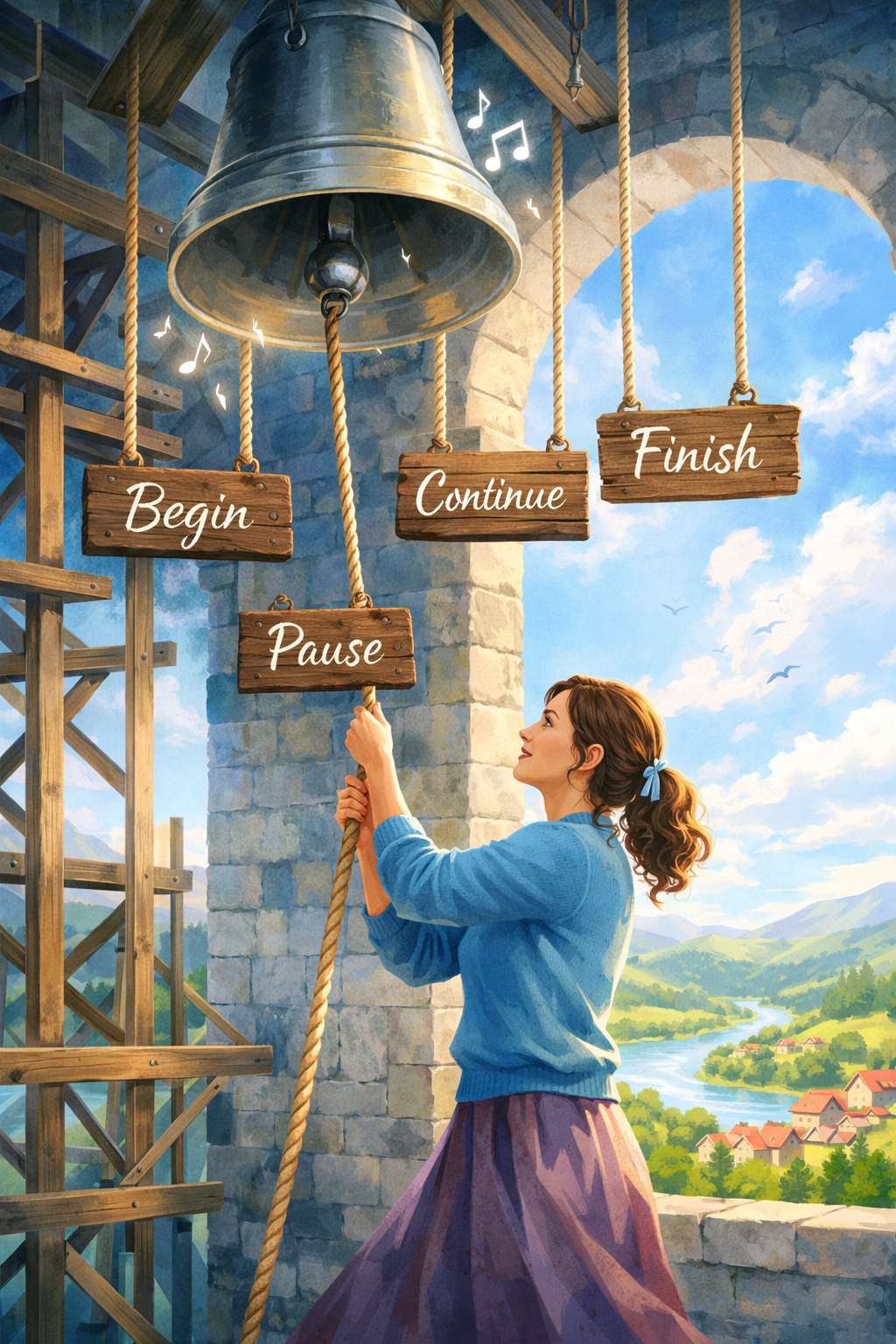
That night, Elin had a vivid dream. In the center of the village stood a tall bell tower that had not been there before. It was unfinished, surrounded by scaffolding, but inside it held several ropes, each one hanging quietly as though waiting. She stepped inside and noticed that each rope had a single word written on it: “Begin,” “Continue,” “Pause,” and “Finish.”
She reached out and pulled the rope labeled “Begin.” A low, steady sound echoed through the air. It wasn’t loud or forceful, but it was clear. It didn’t demand anything from her, yet it marked a moment. It created a shift. She woke with a sense that the bells she had been searching for were never meant to control her, but to guide her.
Learning to Ring the Bells
The next morning, Elin approached her day differently. Instead of waiting for motivation, she asked herself a new question: “Can I begin?” Not the whole day, not everything at once, just one small beginning. She wrote, “Make tea,” and when the moment came, she imagined pulling the rope from her dream. She didn’t feel especially ready, but she began anyway.
Throughout the day, she experimented with the other bells. She practiced continuing a task just a little longer than usual. She allowed herself to pause without guilt, treating rest as part of the rhythm rather than an escape from it. And sometimes, she intentionally finished something small, noticing the quiet sense of completion that followed. The day was not perfect, but it felt different. It had shape.
The Rhythm Returns
As the days passed, the fog didn’t disappear entirely, but it loosened its hold. Elin began to understand that structure wasn’t something that needed to come from the outside world. It could be created from within, one small action at a time. Some days she rang only one bell. Other days, several. What mattered was not perfection, but participation.
She also noticed that the act of beginning held a special kind of power. It was often the hardest part, yet once she started, continuing became easier. And when she allowed herself to pause intentionally, rather than drifting unconsciously, she felt more present, more connected to her own choices.
The Meaning of Movement
One afternoon, while walking along the river, Elin realized that it wasn’t the tasks themselves that mattered most. It was the act of responding to the bells she had created. Each time she began something, she was strengthening a part of herself that had grown quiet—the part that could choose, that could act, that could move forward without needing to feel perfectly ready.
She understood then that momentum wasn’t something you wait for. It’s something you build, gently and repeatedly, through small acts of beginning.
The Practice of Returning
There were still days when Elin drifted. Days when she ignored the bells, when the fog returned and everything felt heavy again. But now, those days no longer meant she was lost. She knew she could return at any moment, not by fixing everything at once, but by reaching for one rope and pulling it.
Beginning again did not require the perfect mood, the perfect plan, or the perfect day. It only required a willingness to engage, even in the smallest way.
And so, in a village without bells, Elin learned to create her own rhythm—not through force or pressure, but through quiet, consistent choice. Over time, her days were no longer empty stretches of drifting time, but living spaces she could move through with intention.
And all it ever took was the courage to begin.