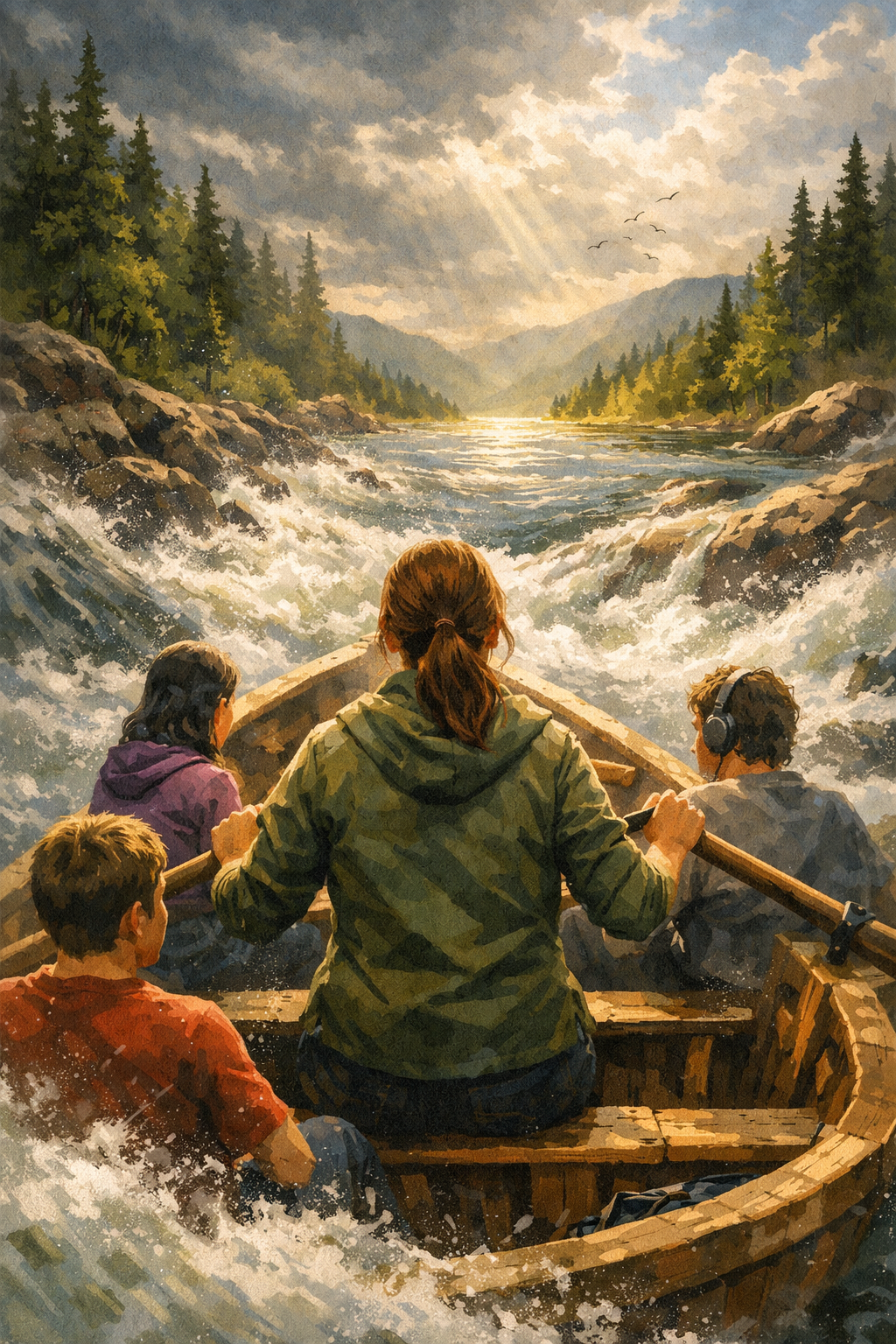
Imagine that somewhere not far from where you live there is a wide, winding river. The river flows through forests, over stones, past quiet towns, and eventually out into a great open lake. Some days the water moves slowly and smoothly. The surface glitters in the sunlight, and the current carries everything gently forward. Other days are very different. The river becomes louder. The water tumbles over rocks and swirls into fast-moving rapids. The current pulls in different directions at once. The boat bumps and tilts and splashes rise up against the sides.
Now imagine that you are a river guide on this river. You did not exactly choose this role. One day you simply found yourself standing in a sturdy wooden boat with several passengers traveling with you. In your hands are the oars that help steer the boat through the journey. Some passengers are energetic and unpredictable. One might disappear into the woods and return long after dark. Another might be frustrated about school, relationships, or the future. A third passenger—your partner—might move more slowly, waking late or drifting in and out of conversation.
From time to time, other travelers step aboard for short stretches of the journey. As you look around the boat, you notice something important: you are the one steering. But being the guide of a river boat comes with a strange and subtle truth. Steering the boat is not the same thing as controlling the river. The river moves according to its own forces—weather, hidden rocks, currents formed far upstream. No matter how skilled the guide becomes, the guide cannot command the river to behave differently. What a guide can learn, however, is how to move through the river skillfully.
Skill One: Staying in the Boat
When the river first begins to grow rough, new guides often react instinctively. They grip the edges of the boat, lean too far in one direction, or try to fight the current directly. They become tense and reactive, responding to every splash and bump. The boat becomes harder to steer.
Experienced guides do something very different. When the water begins to churn, they pause for a moment. They plant their feet firmly on the bottom of the boat and feel the solid wood beneath them. They take a slow breath, then another. This small pause does not calm the river, but it steadies the guide. With that steadiness, the guide can begin to feel the rhythm of the water instead of reacting to every movement.
The oars dip into the current more smoothly. The boat begins to move with the river rather than fighting it. Sometimes the guide rows slowly, sometimes quickly. Sometimes they simply hold steady while the boat passes through a narrow channel. But most importantly, the guide remains in the boat. They do not jump overboard in frustration. They do not shout at the river. They stay grounded and steady while the water moves around them.
Skill Two: Reading the Water
Once guides learn how to steady themselves, they develop a second skill: they learn to read the water. To someone new, rapids appear chaotic and overwhelming. Everything looks like danger, and every wave feels like a crisis. But experienced guides begin to see patterns that others miss. They notice the deeper channels where the current flows more smoothly, small calm patches between waves, and recognize that rapids tend to appear in certain stretches of the river before eventually giving way to quieter water.
When frustration rises in the boat—when passengers argue, when someone returns late at night, or when another passenger is upset or worried—the guide begins to recognize the emotional equivalent of rapids. Inside themselves, irritation might begin to build, thoughts might start racing, but instead of thinking everything is going wrong, the guide quietly says something different: “The water is rough right now.” This simple shift changes the experience. The moment is no longer a permanent disaster; it is simply a stretch of turbulent water. And every river guide knows something important about rapids: rapids are temporary.
A Moment in the Rapids
Now imagine one of those moments when the river suddenly becomes rough. Perhaps one passenger returns very late and the boat feels unsettled. Perhaps another passenger is frustrated about studies or relationships. Perhaps your partner seems distant or difficult to understand. The current begins to churn. Inside you, irritation rises. The mind wants to fix things immediately, to calm everyone, to make the river behave differently.
But this is where the guide remembers their practice. You feel your feet on the floor of the boat, take one slow breath, then another, and quietly say inside your mind, “The water is rough right now.” In this moment, you do not have to solve everything. You do not have to correct every passenger or calm every wave. Your first task is simply to stay steady. Perhaps you make a small steering movement that helps stabilize the boat. You step outside for a walk, write a few lines in a journal, make a cup of tea, or put on headphones and let the noise soften. These are not ways of abandoning the river. They are the small adjustments a skilled guide makes to keep the boat balanced while moving through difficult water.
Finding the Quiet Patches
Something else begins to happen as guides gain experience. They start noticing the quiet patches more clearly. Even on challenging days, the river occasionally opens into calm water. The surface smooths out, and the sunlight reflects gently across the current. These moments might appear in small places: a peaceful morning before the household wakes up, a long walk when the air feels fresh, or a workout at the gym when the body moves and the mind grows quiet.
When the guide reaches one of these calmer stretches, they do something simple: they let themselves rest there. They do not rush to the next task or analyze the moment too quickly. They simply allow the boat to drift in the still water for a little while. Inside themselves, they might quietly say, “Ah. Calm water,” and let the moment last.
The Long Journey of the River
Over many seasons on the river, something important changes. The river itself never becomes perfectly calm. There will always be bends, currents, and unexpected splashes. But the guide becomes stronger, more patient, and more skilled at reading the water. Rapids that once felt overwhelming begin to feel more manageable—not easy, but navigable.
The guide begins to trust something deeper: the boat is strong enough, the river eventually opens again, and each difficult stretch is only one part of a much longer journey. Sometimes, even while moving through rough water, the guide notices something unexpected. The sunlight still glitters on the waves, the trees still lean over the banks, and the journey continues. And the guide—steady in the boat, hands on the oars—keeps steering forward.