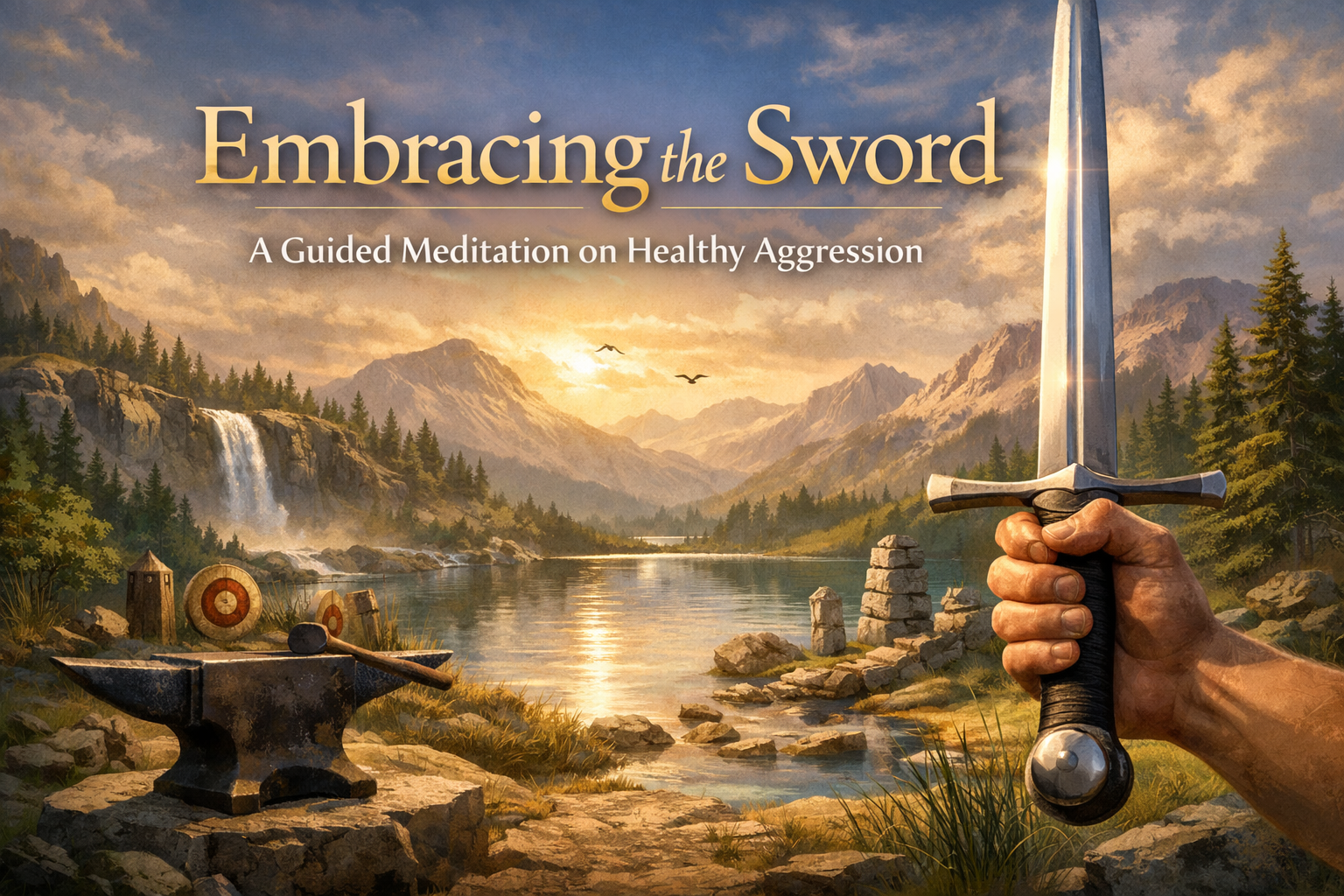
Orientation and Intent
This is a guided meditation designed to help you own aggression cleanly — not to suppress it, not to act it out, and not to moralize it away. Aggression here is recognized as a natural, necessary life force that can be held with clarity, restraint, and choice.
Aggression does not mean violence, cruelty, or loss of control. It means directed force, boundary energy, the capacity to say no, and the willingness to move toward rather than away from. It is the same energy that allows a tree root to split rock, a bird to defend its nest, or a human being to speak a truth that risks friction.
This meditation does not require effort, strain, emotional intensity, visualization skill, catharsis, or belief. Nothing needs to be forced, pushed, summoned, or exaggerated. If at any point you feel you are trying too hard, you are doing more than is required. The work here is largely allowing, noticing, and staying present.
If your mind wanders, that is fine. If images come clearly, that is fine. If nothing much happens, that is also fine. The nervous system learns through exposure and safety, not performance.
You may stop at any time.
Settling the Body
Begin by sitting or lying down in a way that feels stable and unremarkable. Not perfect. Just adequate.
Let your eyes close, or soften your gaze.
Notice that your body already knows how to breathe. You do not need to manage it. Simply let the breath come and go.
Feel the weight of your body being supported — by the chair, the floor, the bed, the ground beneath the building. Gravity is doing its work without asking anything from you.
Allow your shoulders to drop a fraction of an inch.
Allow your jaw to loosen.
Allow your tongue to rest.
There is nothing you need to achieve here.
Establishing Safety First
Before approaching aggression, establish safety. Aggression without safety becomes reactivity. Aggression with safety becomes agency.
Imagine — gently, without effort — that you are inside a protected space. This may appear as a room, a clearing, a shoreline, a cabin, a stone circle, or something abstract.
This space is:
- Enclosed enough to feel secure
- Open enough to breathe
- Neutral, not charged
Nothing enters this space unless you allow it.
Take a moment to sense the edges of this space — the walls, the trees, the horizon, the boundary. You do not need to guard them. They simply exist.
Notice how your body responds to having a boundary that does not need defending.
Let that register.
Reframing Aggression
Now, consider quietly:
- Aggression is not the opposite of love.
- Aggression is not the opposite of peace.
- Aggression is not the same as anger.
Aggression is life force with direction.
It allows:
- A boundary to be drawn
- A truth to be spoken
- A path to be cleared
- A presence to be felt
Let go of any images of aggression as chaotic, explosive, or morally suspect.
Instead, let aggression appear as something clean, contained, and responsive — like a blade kept sharp and sheathed, a guard dog that lies calmly until needed, or a storm cloud that holds rain without flooding.
Notice if your body recognizes this distinction.
The Connection to Assertiveness
Clean aggression is internal capacity — potential energy. Assertiveness is its outward expression.
Without internal aggression, assertiveness can feel weak, apologetic, or inconsistent. Without the skill to channel it outward, aggression remains dormant — a sword never drawn. When both are aligned, you can act with precision, timing, and clarity.
Clean aggression gives rise to effective assertiveness: a presence that can enforce boundaries, speak truth, and clear obstacles without overreaction or depletion. It allows you to choose when, how, and whether to act, creating both power and calm.
This meditation cultivates that alignment: by recognizing and owning aggression internally, assertiveness flows naturally when needed. You may act or remain silent — either way, your presence is grounded, complete, and coherent.
The Metaphorical Landscape
Now, imagine yourself standing in a wide, open landscape.
The ground beneath you is solid. The sky above is expansive. There is good visibility in all directions.
You are not rushing. You are not hiding. You are simply there.
Somewhere in this landscape is a path — your path. It represents your movement through life when you are aligned, honest, and unfragmented.
Notice that parts of this path are clear. And parts of it are obstructed.
The obstruction is not dramatic. It is not an enemy. It is simply in the way.
This obstruction represents moments in life where a small amount of clean aggression is required — a no that needs to be said, a line that needs to be held, a movement that requires firmness rather than accommodation.
Pause here. You are not yet acting.
Meeting the Aggressive Energy
Now notice that you are carrying a tool.
This tool is not a weapon. It is not excessive. It is not ornate.
It is precisely suited for clearing the path.
It might be:
- A sword or simple blade
- A staff
- An axe
- A controlled flame
- A focused beam of force
- Or something symbolic that feels right
You did not invent this tool. It is something you already know how to use.
Notice how it feels in your hands — or how it responds to your intention.
There is no rush.
The Key Instruction: No Extra Effort
Before doing anything, absorb this:
- You do not need to summon intensity.
- You do not need to justify yourself.
- You do not need to feel angry.
- You do not need to prove strength.
The aggression here is functional, not emotional — like using a knife to cut fruit or pushing a door that is meant to open.
Let your breath remain natural.
Clearing the Obstruction
When ready — and readiness may simply feel like neutral clarity — bring the tool to the obstruction.
- You do not attack it.
- You do not dramatize it.
- You apply just enough force.
Notice:
- The precision of the movement
- The absence of excess
- The lack of emotional charge
The obstruction yields — not violently, not resentfully. It simply gives way.
You may clear a section, then another.
At no point are you depleted. At no point are you flooded.
This is aggression without collapse.
Integrating the Sensation
Pause and notice your body.
Where do you feel this energy?
- Perhaps in the arms, chest, belly, spine
- Or as an overall sense of solidity
This energy does not buzz, leak, or demand expression. It is available.
Notice how different this feels from anger, irritation, or defensiveness.
Owning Without Acting
Imagine a situation from your real life — lightly, at a distance — where you typically over-accommodate, freeze, or absorb pressure.
- Do not replay the scene.
- Do not analyze it.
- Simply place this clean aggressive capacity beside it.
Notice how the situation looks different when you know you could act — even if you don’t.
Agency changes perception. Let that register.
The Boundary Visualization
Imagine standing still.
Around you, at a comfortable distance, is a boundary.
- Not a wall. Not a shield.
- A field — permeable, but firm.
You do not push it outward. You do not hold it in place.
It exists because you exist.
Notice how aggression lives inside this boundary as a quiet guardian.
Nothing leaks out. Nothing intrudes.
Final Integration
Take a moment to sense:
- Your weight
- Your breath
- Your presence
You are not more aggressive than before. You are not less kind.
You are less split.
Clean aggression belongs to you. It does not need rehearsal or permission. It will arise naturally when required — and remain dormant when not.
Closing
Let the imagery soften. Let the landscape fade.
Return your attention to the room you are in. Wiggle fingers or toes if helpful.
When you open your eyes, do so without hurry.
Carry nothing extra with you.
The work is already done — by recognition, alignment, and ownership.