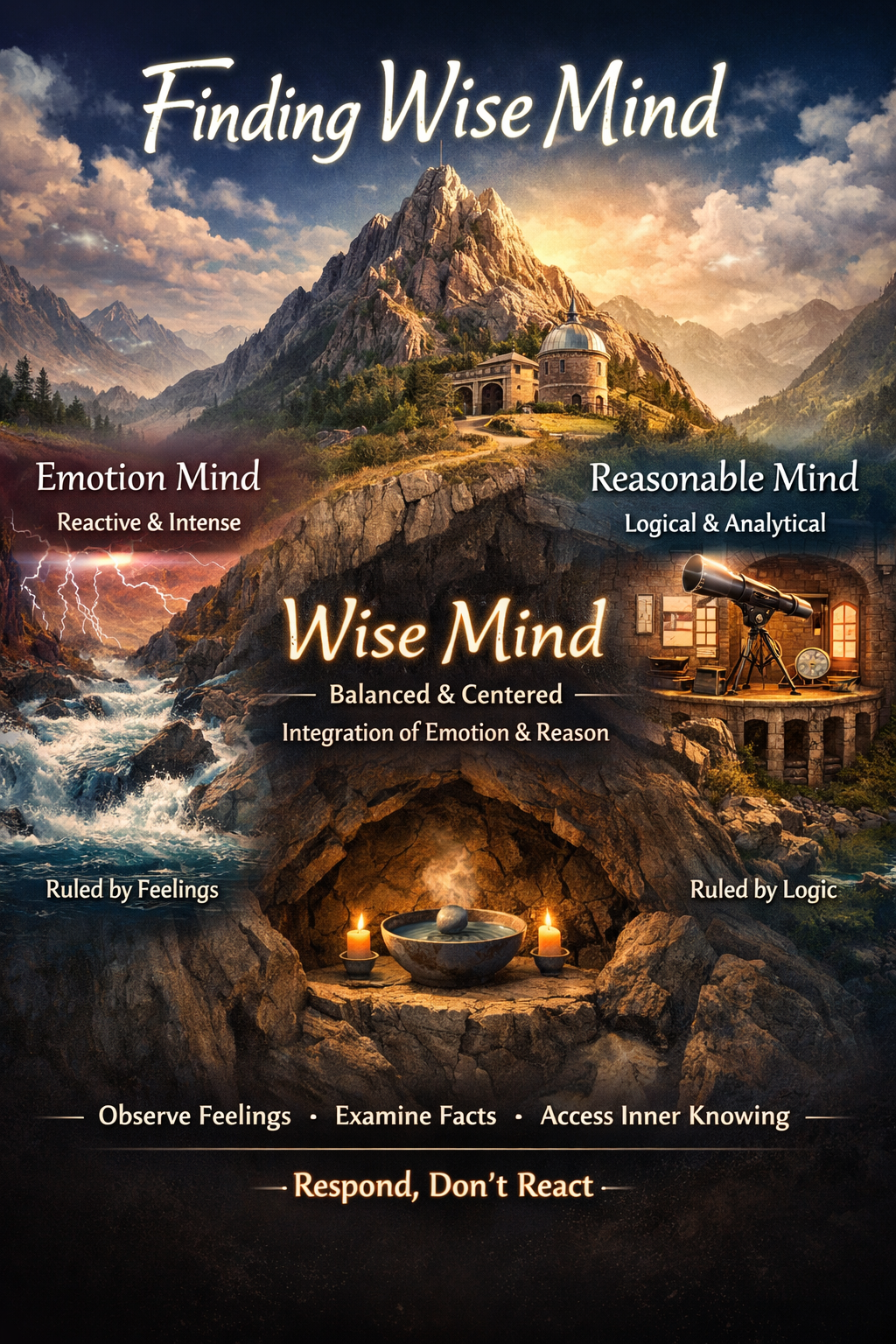
Understanding the Three Minds
Before you climb the mountain, you need to understand the terrain.
In Dialectical Behavior Therapy, there are three primary states of mind: Emotion Mind, Reasonable Mind, and Wise Mind.
Emotion Mind is when feelings dominate perception. When you are in Emotion Mind, your inner state defines reality. If you feel rejected, you assume rejection. If you feel powerful, you assume dominance. If you feel threatened, you prepare for battle. Emotion Mind is fast, intense, and compelling. It is not irrational — but it is partial. It sees through the lens of urgency.
Reasonable Mind is the opposite pole. It operates through logic, data, structure, and calculation. It analyzes facts, weighs probabilities, and makes strategic decisions. It is calm and often detached. Reasonable Mind is excellent for planning, evaluating risk, and organizing action. But by itself, it can become sterile, overly analytical, even disconnected from human nuance.
Wise Mind is not a compromise between the two. It is their integration. It includes emotion, but is not ruled by it. It uses reason, but is not limited to it. It is the deeper knowing that emerges when both systems are acknowledged and neither is allowed to hijack behavior. Wise Mind feels grounded, clear, and steady.
You don’t manufacture Wise Mind. You access it.
The Mountain, The River and The Observatory
Imagine a mountain rising from the earth. At the base runs a powerful river. It moves quickly, crashing against rocks, swelling during storms, thinning during drought. It changes direction without warning. It is alive.
This river is Emotion Mind.
Higher up the mountain, carved into the rock, sits a stone observatory. Inside are maps, instruments, measurement tools, records of past weather patterns. It is quiet, cool, and calculated.
This observatory is Reasonable Mind.
But the mountain itself — solid, grounded, unmoved by the fluctuations of river or weather — represents Wise Mind. Wise Mind is not the turbulence, not the analysis; it is the structure that holds both.
Step One: Standing at the River (Observing Emotion Without Fusion)
Picture yourself at the river’s edge. Do not jump in. Do not build a dam. Just stand and observe.
What emotions are present in you right now? Not the polite ones. The real ones: irritation, ambition, attraction, shame, competitive drive, anxiety, pride, fatigue, hunger for validation, fear of being misunderstood. Name them silently.
“This is anger. This is anxiety. This is desire. This is pressure.”
Notice what happens when you label rather than react. A small space opens. That space is the beginning of freedom.
Most people don’t stand at the river. They fall into it. When they feel anger, they become anger. When they feel attraction, they become pursuit. When they feel shame, they collapse into self-judgment. You are practicing something different: observing emotion without fusing with it.
Emotion Mind contains valuable data, but it does not get executive control. Stay on the bank and watch the current move.
Step Two: Entering the Observatory (Reasoning Without Coldness)
Now turn and walk up the mountain path. As you climb, the roar of the river softens. You enter the observatory. The air is steady here.
From this vantage point, describe your current situation using facts only. Remove interpretation, emotional adjectives, and narrative.
Instead of “She was disrespectful,” try: “She interrupted twice and did not respond to my last message.”
Instead of “He’s manipulative,” try: “He asked for clarification in front of the group.”
Instead of “I’m failing,” try: “I missed my target this quarter.”
Reasonable Mind creates clarity. It prevents emotional exaggeration and protects against impulsive reaction. But if you remain in the observatory too long, you become rigid, hyper-calculating, disconnected from your own humanity and the humanity of others. Reason without emotion can justify almost anything. Wise Mind is not cold logic; it is embodied clarity.
Step Three: Entering the Cave (Accessing Wise Mind)
Leave the observatory. Walk halfway down the mountain and find a small cave entrance carved into the rock. Enter it. Inside, there is stillness. You can faintly hear the river below and faintly remember the maps above, but here there is quiet.
This is where Wise Mind resides. Sit down.
Ask yourself one simple question:
“What do I already know is true?”
Not what you want to be true, not what would protect your ego, not what would win the argument. Wait. Wise Mind answers feel different — steady, calm, and simplifying.
It may say: “You’re overextending,” or “You’re tired, not oppressed,” or “You don’t need to escalate.” Wise Mind stabilizes rather than inflates or collapses.
The Integration Ritual
Imagine bringing a bowl of river water into the cave. You also bring a small stone from the observatory. Place both before you. The water represents emotion; the stone represents reason.
Place the stone into the water. The surface ripples, then settles. This is integration.
Emotion informs. Reason structures. Wisdom chooses.
Apply this to a real-life tension, conflict, or decision. Ask: What does Emotion Mind want? What does Reasonable Mind conclude? What does Wise Mind choose?
Emotion Mind may demand intensity. Reasonable Mind may demand optimization. Wise Mind often chooses proportion. This is strength without overreach.
The Breath That Unlocks Wise Mind
Wise Mind is easier to access when your nervous system is regulated. Place one hand on your chest and one on your abdomen. Inhale slowly for four seconds. Pause for two. Exhale for six.
Longer exhales signal safety to your body. When physiology settles, Emotion Mind stops flooding perception, and Reasonable Mind stops overcompensating. Wise Mind emerges naturally.
The Non-Reaction Drill
For the next 24 hours, practice this: when you feel an emotional spike, delay your reaction by ten seconds.
Internally say, “This is the river.” Then ask, “What would the mountain do?”
Those ten seconds widen the space between stimulus and response. That space is power — not dominance, not suppression, just control.
The Hard Truth
Wise Mind will not always flatter you. Sometimes it says: “You pushed too hard,” “You’re projecting,” or “You’re attracted to chaos again.”
If you truly want alignment, you must prefer truth over image. Growth happens when Wise Mind challenges your narrative. That requires maturity.
The Sky Above
Above the mountain is the sky. Storms move through it. Sunlight fills it. Clouds gather and dissolve. The sky does not cling or resist.
Wise Mind is like that: it allows emotion, it allows logic, it does not become either. Alignment is practiced, not permanent.
Return to the cave again and again, not to escape life, but to lead it. Ask yourself: where am I drowning in the river? Where am I hiding in the observatory? Where do I need to sit in the cave?
Choose one small behavioral shift today that reflects Wise Mind. Not a dramatic overhaul, just a precise adjustment. That is how integration becomes identity.