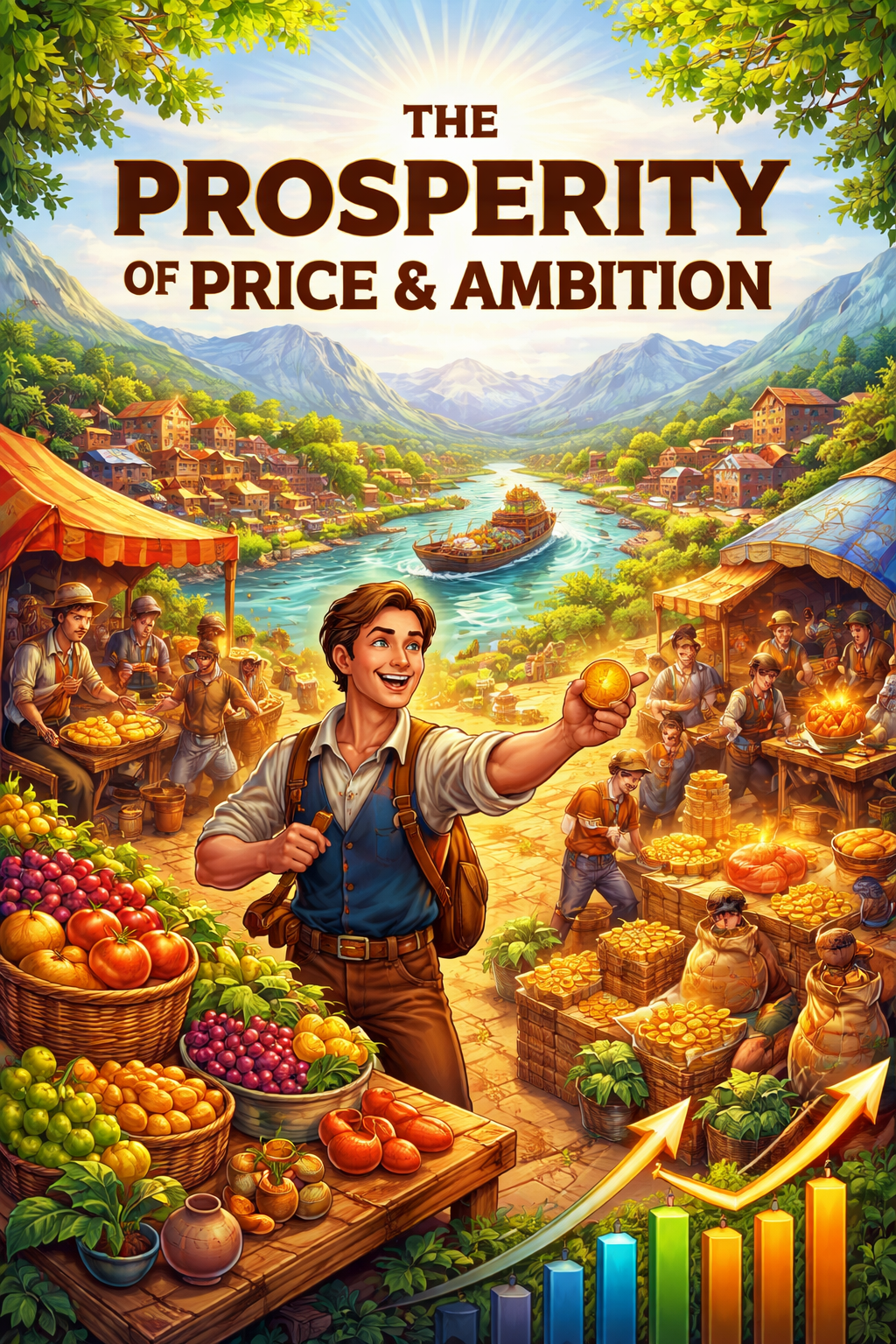
The Market on the Edge of the River
In a wide valley bordered by forests and gentle hills, a long road wound down toward a river port. Along this road stood a settlement called Crossroads Market. It had no central planning hall and no council assigning each person their work. Instead, it ran on a simple rhythm: people arrived with goods, ideas, and effort, and each day the market decided what those things were worth.
Every morning stalls opened like flowers in sunlight. Bakers laid out bread still warm from the oven. Gardeners displayed baskets of fruit. Fishermen unloaded silver crates of river catch. Toolmakers hung hammers and knives along wooden beams so their balance and craftsmanship could be seen.
But the most important feature of the market was not the goods themselves.
It was the small wooden boards hanging from each stall: prices.
Those numbers changed constantly. If fish were abundant that day, their price dropped so they would sell before spoiling. If a carpenter produced a table stronger than the others, buyers willingly paid more for it. When a drought reduced grain harvests, the price of bread rose, quietly signaling farmers and traders that grain had become more valuable.
The numbers were not commands. They were messages.
Price told everyone in the market three things at once: how scarce something was, how much people wanted it, and where effort should go next.
The Living Language of Price
Over time the people of Crossroads Market learned to read prices the way sailors read wind.
When copper became expensive, metalworkers began searching for more efficient ways to use it. When spices sold at a high price, traders sailed farther downriver to find new sources. When bread prices rose too high, farmers planted more wheat the following season.
No council had to instruct them.
The price itself carried the information.
A high price meant more of this is needed.
A falling price meant the need is already being met.
Because of this constant feedback, the market behaved almost like a living organism adjusting to its environment. Resources flowed toward the places where they created the most value.
Sometimes mistakes were made. A merchant might overproduce something no one wanted. A craftsman might invest months in a design that failed. But those losses also carried information, guiding future effort in a better direction.
The market learned through millions of tiny experiments.
The Garden of Equal Rows
Across the meadow stood another settlement called The Garden of Equal Rows. From above it looked almost perfect. Fields were divided into identical rectangles, and every house lined up neatly along straight roads.
At the center stood a council pavilion where leaders planned production and distributed the harvest.
The villagers believed fairness meant everyone should contribute equally and receive equally. Farmers farmed according to schedules assigned by the council. Bakers baked the required number of loaves. Carpenters built the tools listed on the seasonal plan.
Every harvest was gathered into communal barns and redistributed so each household received its share.
But unlike the market, the Garden of Equal Rows had no prices.
Bread was simply bread. Tools were simply tools. Fish were simply fish.
Without prices changing to reflect scarcity or demand, the villagers had no natural signal telling them what the community needed most at any given time.
Instead, the council had to guess.
When Harvests Grew Thin
One year the rains came late.
The wheat harvest shrank, and the communal granary began to empty sooner than expected. The council gathered in the pavilion and reduced each household’s ration so the food would last through winter.
The villagers accepted the decision. They worked diligently in their assigned roles.
But a quiet problem emerged.
Without price signals, farmers had no clear reason to shift more land toward wheat. Bakers could not tell when bread had become unusually valuable. Toolmakers continued producing the same equipment because the seasonal plan required it.
Everyone worked.
Yet the system struggled to adapt.
The Quiet Lines at the Granary
Over the following seasons, shortages appeared more often. On certain mornings, small lines formed outside the communal granary. People waited patiently for their share of bread or grain.
Sometimes supplies ran out before everyone was served.
No one had intended for this to happen. The villagers were not lazy, and the council was not malicious. But without prices acting as signals, the system had difficulty directing effort toward the most urgent needs.
Information moved slowly through meetings and plans.
Meanwhile, tools wore out, crops fluctuated, and weather changed.
The neat rows remained equal.
But the margin for error grew thinner each year.
The Workshop by the Docks
Back in Crossroads Market, the river trader Elias had built a small workshop near the docks. It began with repairing fishing nets, but something interesting happened.
One fisherman noticed Elias’s nets lasted longer and offered to pay extra for them. Another fisherman asked if the nets could be modified for deeper waters and offered an even higher price.
Soon Elias realized that the price people were willing to pay revealed something important: durable nets were more valuable than ordinary ones.
So he improved them.
The higher price allowed him to hire apprentices. The apprentices experimented with stronger fibers. The rope maker nearby began growing more of the plant used to produce that fiber because its price had risen.
In a short time, a small cluster of industries formed around something as simple as a fishing net.
None of it required a central plan.
Prices quietly guided the effort.
The Conversation at the Bridge
One evening Elias met a farmer from the Garden of Equal Rows at the wooden bridge between the two settlements.
They sat watching the river flow beneath them.
“In your market,” the farmer said, “people constantly adjust what they produce. How do they know what the community needs?”
Elias picked up a small stone and tossed it into the water.
“The price tells them,” he said.
“If bread becomes expensive, farmers grow more grain. If tools become cheap, craftsmen know the supply is already plentiful. The numbers guide everyone’s effort without anyone needing to command it.”
The farmer looked thoughtfully toward the distant market lights.
“In our village,” he said quietly, “we try to decide everything together. But sometimes we still end up with shortages.”
Elias nodded gently.
“Because the information about scarcity and demand has nowhere simple to appear.”
The River’s Lesson
In his later years, Elias often sat on the docks watching the river flow toward the great lake. He had come to see the market not simply as competition, but as a vast communication system.
Every price was a signal.
Every transaction carried information.
Every success or failure taught the community something.
Through that constant feedback, the system adapted.
The Garden of Equal Rows had sought fairness and stability, and its intentions were sincere. But by removing the mechanism that revealed scarcity and value—the changing language of prices—it had made coordination far more difficult.
The river itself offered the clearest metaphor.
It did not move because someone directed each drop of water. It moved because countless tiny currents responded to the shape of the land, finding their path through feedback and flow.
In the same way, the market allowed millions of individual decisions to organize themselves into something larger: a dynamic system capable of discovering, again and again, how best to create abundance.