Learning to Leave the Table
The First Coin
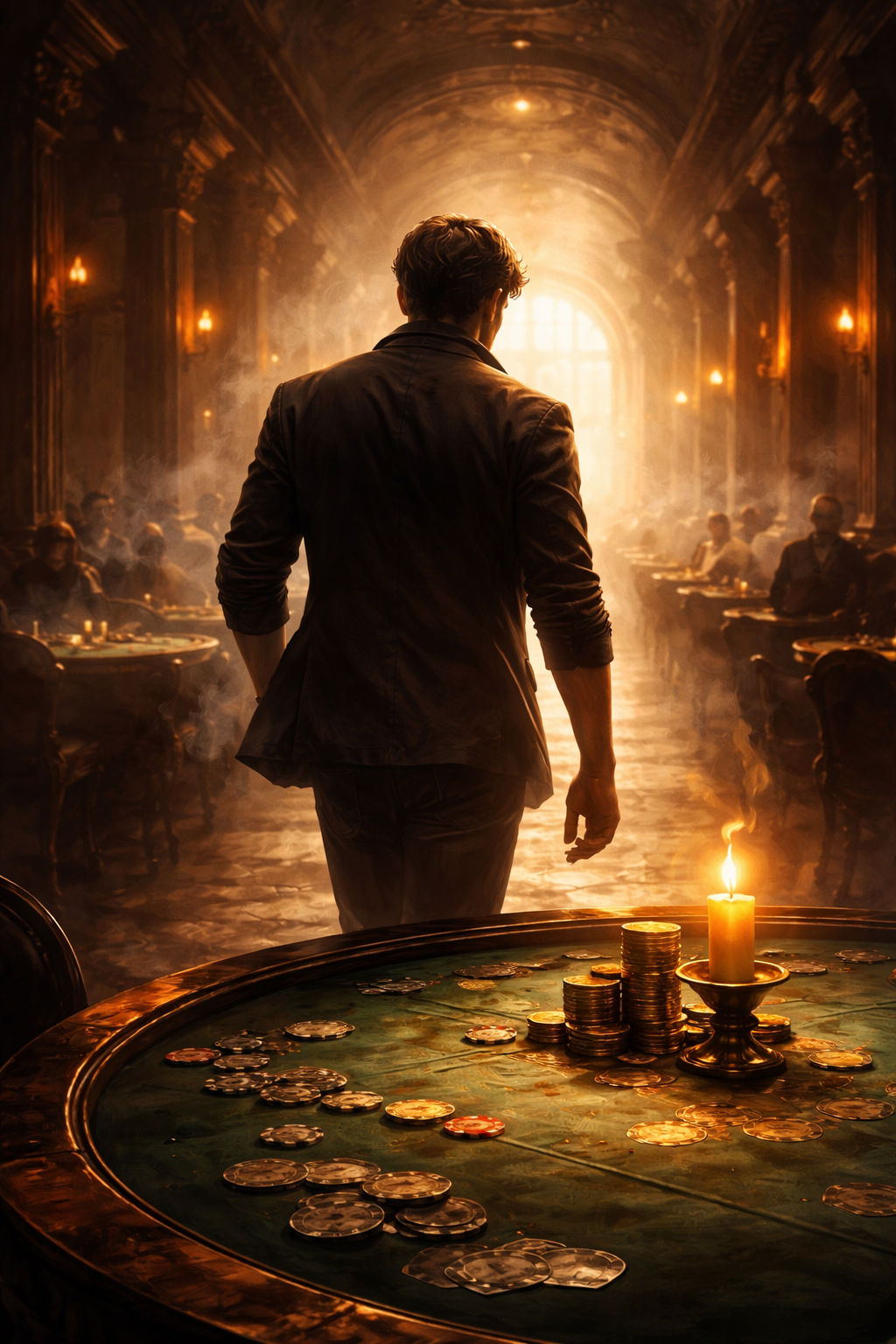
The hall was vast, almost cathedral-like, filled with rows of polished tables under warm, golden light. Each table offered a different game—some loud and chaotic, others quiet and surgical. He chose one without much thought. It looked simple. Familiar enough. He placed a coin down, that first game was lost, and his money vanished almost instantly. A small loss. Barely worth noticing. But something in him stirred—not quite pain, not yet—but a faint irritation, like a sentence left unfinished. So he placed another coin, this time leaning forward.
The Subtle Shift
Hours passed unnoticed. The rules of the game had not changed, but something in him had. At first, he had been playing to win. Now, he was playing to recover. Each coin carried a quiet justification—just evening things out, just getting back to neutral, just closing the loop. The table no longer invited curiosity; it demanded obligation. The first coin, long gone, had begun to echo.
The Quiet Captivity
Around him, the hall breathed. Players laughed, cursed, stood up, and walked away. Some left with less than they came with, but they left clean. He noticed something unsettling: they seemed lighter. He, on the other hand, felt anchored—not by the coins themselves, but by the story attached to them. I started this. I’m not the kind of man who walks away unfinished. The game was no longer external. It had moved inside him.
The Man Who Was Not Owned
One evening, a man sat beside him—unremarkable at first glance. He played a single round, lost, and stood up immediately. No hesitation. No recalibration. No second attempt. The trader frowned. “You’re leaving already?” The man paused, as if the question itself needed translation. “Yes.” “You just lost.” “I know.” “And you’re fine with that?” The man looked at the table, then back at him. That coin is no longer part of reality.
The Fracture
The words lingered. Not part of reality. The trader felt resistance rise immediately. Of course it was real—he felt it. The loss, the pull, the need to respond. But beneath the resistance, something else appeared. A crack. He looked down at his hands and realized that however many coins he had placed, none of them were coming back. Not through effort, not through persistence, not through loyalty to the past. And yet every move he made was still answering them.
The Forbidden Question
He leaned back for the first time in hours and let the game continue without him. Then he asked the question he had been avoiding: If I had never sat at this table, would I choose to sit down right now? The answer came quickly. Clean. Unemotional. No. Not even close. The realization didn’t feel dramatic. It felt quiet—like a truth that had been waiting patiently for him to stop talking long enough to hear it.
The Fire on the Table
The man returned the next night and placed a small, steady flame between them. “For what?” the trader asked. “For clarity.” The man held an imaginary coin over the flame and released it. It disappeared without resistance. No sound, no struggle. “Do it,” he said. The trader hesitated, then imagined his first coin. He felt its weight, its expectation—and let it fall. Gone. He tried another. Gone. Each one vanished the same way. No redemption. No narrative closure. No meaning carried forward. Just release.
The Only Law
“From this moment on,” the man said quietly, “you are bound by a single law.” The trader listened. Before any move, ask yourself: if this were your first move here, would you still make it? No exceptions. No appeals to history. “What about what I’ve already put in?” the trader asked. The man shook his head. That belongs to a world that no longer exists.
The Severing
He turned back to the table. Nothing about it had changed—the same rhythms, the same subtle pulls—but the weight was gone. Or rather, he could now see that the weight had never been in the table. It had been in his refusal to let the past die. He stood. There was no dramatic exit, no declaration, no victory. Just a quiet disengagement. Coins remained behind—unclaimed, unrecovered, and, for the first time, unimportant.
The World Beyond
Outside, the air felt different. Not lighter, but cleaner. The world was filled with other tables—opportunities, risks, unknowns—but there was no urgency to resolve anything, no need to prove continuity. Each step forward stood on its own. No ghosts attached. No past demanding validation. Only one question remained: Would I choose this now?
The Discipline of Freedom
In time, he realized something most people never do. Freedom was not a feeling. It was a discipline. It required him to let go again and again of the subtle urge to recover, to complete, to justify, to redeem. The old voice would return, sounding reasonable as ever: Just one more—then you can walk away clean. But now he could see it clearly. That voice did not lead to closure. It led to chains. So he answered it the same way, every time: There is nothing to close.
The Formidable Man
He became difficult to trap. Not because he avoided risk, but because he refused to negotiate with the past. He could engage fully and disengage instantly. He could invest deeply without becoming owned. He could walk away without needing to be right. His decisions belonged only to the present.