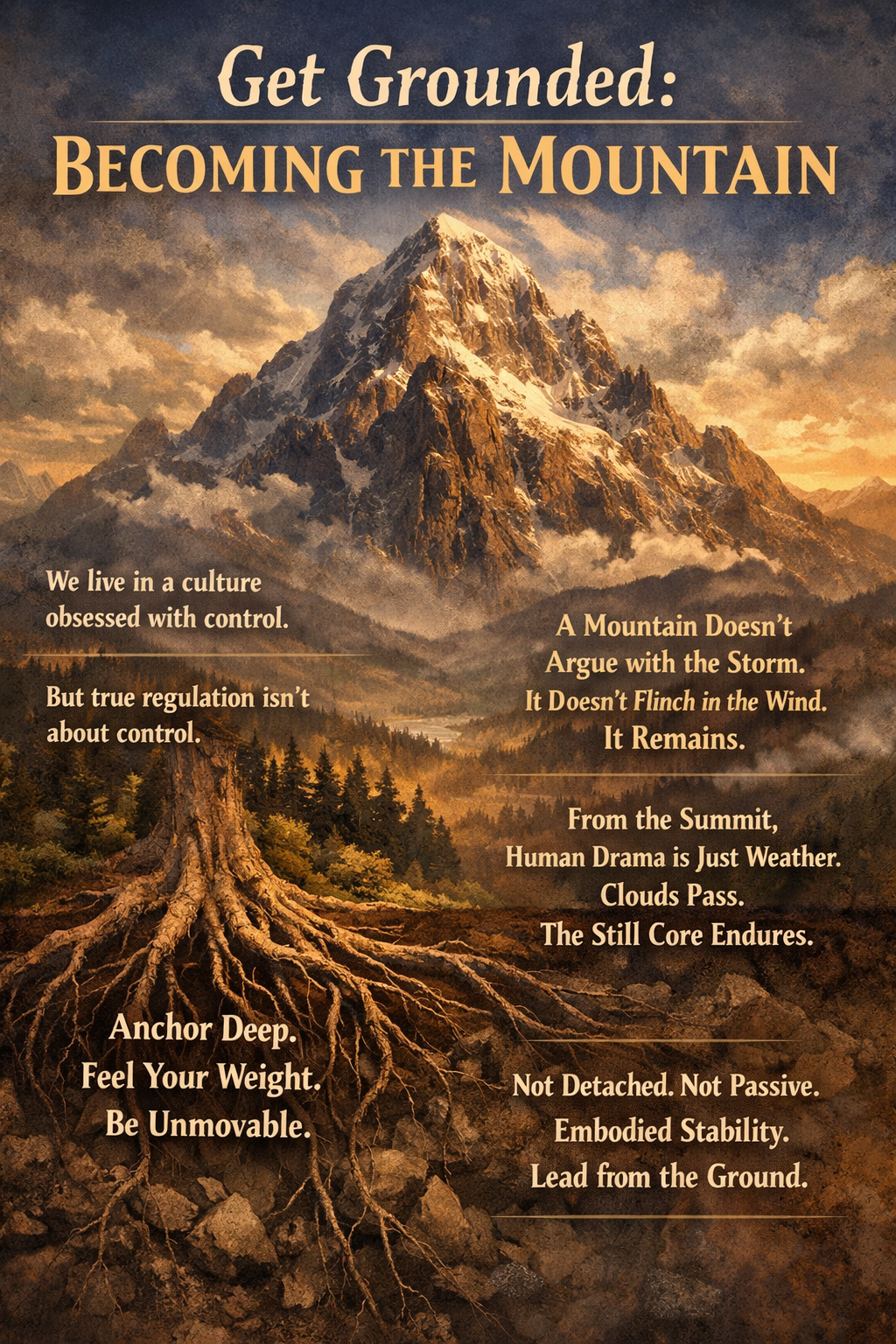
We live in a culture obsessed with control.
Control your emotions.
Control your reactions.
Control your image.
But what if regulation isn’t about control at all?
What if true regulation looks less like emotional suppression—and more like becoming unmovable?
Most people think groundedness means being calm, agreeable, or unreactive. In reality, many of those behaviors are signs of freeze: disengagement masquerading as maturity. What’s missing is mass—a felt sense of weight, presence, and internal stability that doesn’t require constant self-monitoring.
Think of a mountain.
A mountain doesn’t manage the weather.
It doesn’t argue with storms.
It doesn’t tighten when the wind rises.
It remains.
In professional environments—especially high-pressure, emotionally charged ones—people are constantly pulled into other people’s nervous systems. Urgency spreads. Anxiety recruits. Reactivity escalates. The ungrounded person gets dragged sideways, even when they’re competent, intelligent, and well-intentioned.
The regulated person doesn’t “win” these moments by being quieter or nicer.
They win by being heavier.
Groundedness is not a personality trait.
It’s a physiological state.
When someone is truly anchored—when their nervous system has depth rather than tension—they change the field around them. Conversations slow down. Conflicts lose momentum. Others either regulate in response…or reveal their dysregulation more clearly.
This is not spiritual bypassing.
It’s not detachment.
It’s embodied leadership.
In the coming piece, I’ll explore a grounding metaphor I often use in clinical and professional contexts: Becoming the Mountain. Not as imagery for escapism—but as a practical way to understand presence, regulation, and authority that doesn’t rely on force.
Because the people who make the biggest impact aren’t the loudest or the calmest.
They’re the ones who don’t move when everything else does.Settle into your position.
You don’t need to sit perfectly.
You don’t need to perform calm.
Just allow your body to arrive where it already is.
Notice the weight of yourself.
The fact that gravity has never once forgotten you.
Take a slow breath in through the nose…
and let it leave through the mouth, unforced.
Again.
Inhale—like you’re drawing air into your bones.
Exhale—as if something unnecessary is being set down.
The Ground That Was Always There
Imagine the surface beneath you.
Not just the floor, not just the chair—
but the land beneath that.
And beneath that.
And beneath that.
Layers.
Wood.
Concrete.
Stone.
Packed earth.
Ancient soil that remembers things you don’t.
You are not floating above life.
You are resting on top of a history.
Let your awareness sink downward,
as if your attention itself has weight.
Your feet, your legs, your hips—
they are not holding you up.
The Earth is holding them.
You don’t need to grip.
You don’t need to brace.
Gravity is a promise that has already been kept.
Roots Without Effort
Now imagine—without strain, without fantasy—
that from the base of your body,
roots begin to extend downward.
Not decorative roots.
Not polite ones.
Old roots.
Thick roots.
Roots that don’t ask permission.
They move through soil,
through rock fractures,
through dark layers where nothing needs to be explained.
These roots are not searching.
They know where to go.
They anchor into pressure.
Into density.
Into time.
Notice what happens in your nervous system
as you stop being a surface creature
and become a subterranean one.
You are not here to react to every vibration above ground.
You are connected to something that does not flinch.
The Shift From Person to Presence
Let go of the idea of yourself as a “person” for a moment.
No roles.
No reputation.
No ongoing storyline.
Just mass.
Just matter.
Just being.
Now imagine your body slowly, quietly,
becoming heavier.
Not sluggish—
inevitable.
Your breath deepens, not because you force it,
but because shallow breathing no longer makes sense.
Your shoulders drop
because there is nothing they need to defend.
Your jaw softens
because nothing is being hunted or hunted by you.
Becoming the Mountain
Picture a mountain.
Not a dramatic one.
Not a postcard mountain.
A real mountain.
Scarred.
Uneven.
Patient.
This mountain has been misunderstood as passive.
But it has endured ice ages.
It has watched forests rise and fall.
It has been climbed, mined, renamed, worshipped, ignored.
And it has not moved an inch in response.
Now feel that mountain inside you.
Your spine becomes its ridge.
Your hips its base.
Your chest its massive, unyielding core.
Thoughts may still pass through—
clouds do that.
Weather happens to mountains.
It does not define them.
Notice how the mountain does not tense
when the wind picks up.
It doesn’t try to be liked by the weather.
The Human World Below
Now, imagine the world at the base of the mountain.
People rushing.
Arguing.
Performing urgency.
From up here, their dramas look like weather patterns—
loud, but brief.
You are not superior to them.
You are not available to be pulled sideways by them.
The mountain does not shout back at the storm.
It doesn’t explain itself to the rain.
It allows.
And because it allows, it remains.
The Still Core
Bring your attention now to the very center of your body—
somewhere behind the sternum,
deep, quiet, unmoving.
This is your bedrock.
This place does not negotiate.
It does not panic.
It does not rush to interpret.
From here, responses arise slowly,
or not at all.
Feel how different that is from reacting.
You are not shutting down.
You are settling in.
Integration: Walking as a Mountain
Now imagine standing up—
not physically yet, but internally.
Imagine walking through your day as this mountain.
Each step deliberate.
Each word measured.
People may project onto you.
Storms may test you.
And still—
your roots remain underground,
your mass remains intact.
You do not need to prove your solidity.
It is felt.
Returning, Without Losing It
Begin to gently notice the room again.
The temperature.
The sounds.
The simple fact of being here.
Wiggle fingers or toes if you like—
not to leave the mountain,
but to bring it with you.
Take one final breath, deep and grounded.
When you open your eyes,
do so slowly.
You are not “coming back.”
You are allowing the world to reappear
around something that was already stable.
You are not trying to be calm.
You are becoming the mountain—
and letting everything else move around you.