At the Edge of the Kingdom
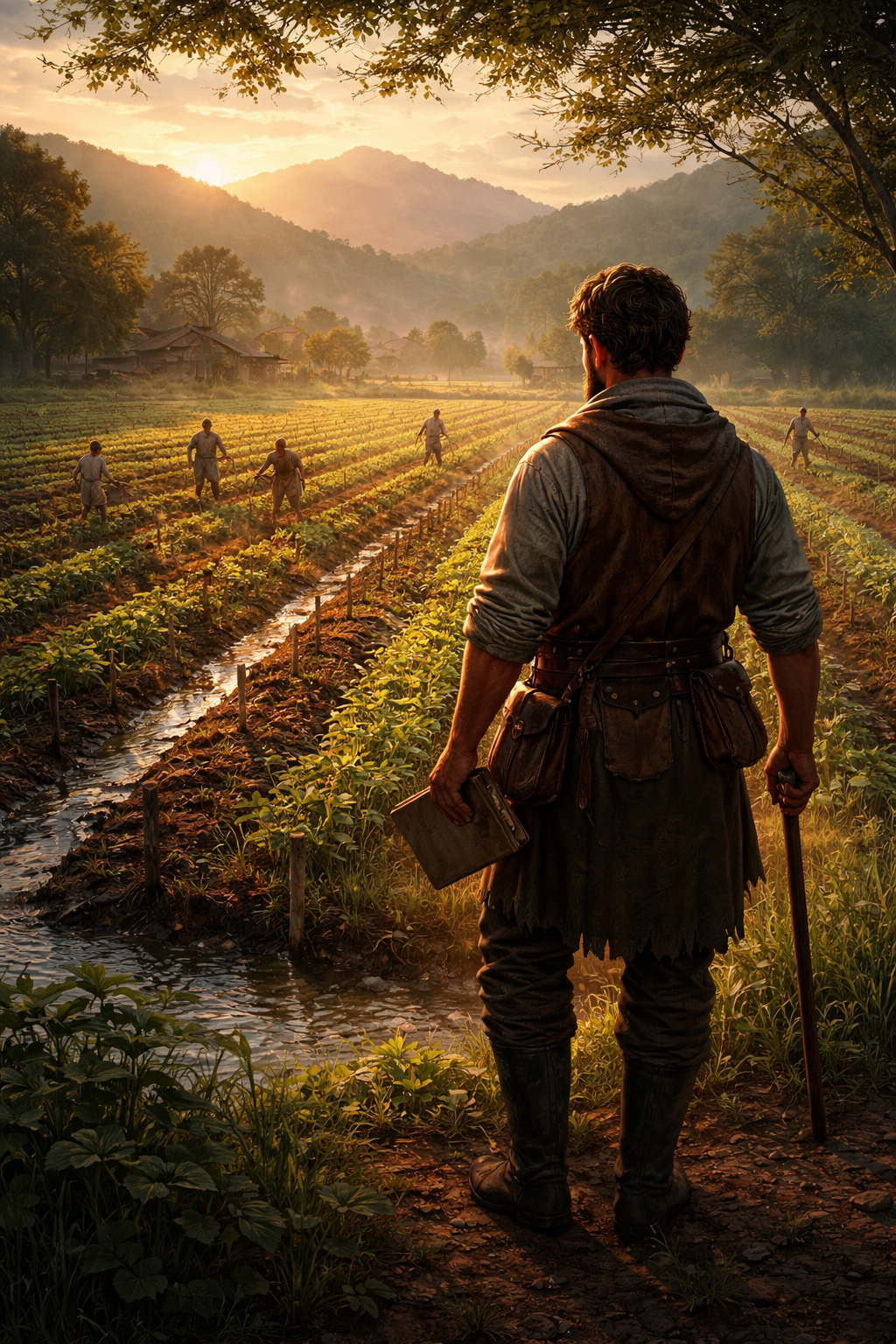
At the far edge of a working kingdom—where the roads were more often repaired than admired, and the fields mattered more than the flags—there lived a man named Soren. He did not think of himself as remarkable. Each morning, he woke before the light fully broke over the hills. He checked the fences along the east pasture. He walked the irrigation channels to make sure the water flowed cleanly and steadily. He kept records in a small, weather-worn ledger—numbers neat, observations brief. When something broke, he fixed it. When something needed doing, he did it. No one had ever called him a leader, and Soren had never thought to question that.
The Field That Wouldn’t Hold
One spring, after a winter that lingered too long, the western field began to fail. The soil didn’t hold water properly. Seeds took unevenly. Patches of growth appeared and disappeared without pattern. Others had noticed it too, but mostly in passing. “Strange year,” one of the workers said. “Nothing to be done,” said another. Soren said nothing at all—but the field stayed with him.
That evening, instead of closing his ledger, he opened it again. He mapped the field in careful lines. Noted where the soil seemed dry, where it clumped, where growth faltered. The next morning, he arrived earlier than usual and walked the entire perimeter again—this time slower. He wasn’t trying to solve it. He was just paying attention.
The Quiet Decision
Days passed, then a week. Soren began adjusting small things. He redirected a minor water channel—not drastically, just enough to test how the soil responded. He spaced the seeds differently in one section. He marked the areas that improved, even slightly. No one asked him to do this. No one told him not to. At first, no one noticed—and that suited him.
The First Question
One afternoon, a younger worker named Elia approached him. She pointed to the small wooden stakes placed in uneven rows and asked why he was marking the field like that. Soren paused. He wasn’t used to explaining his actions. Usually, the work spoke for itself—or didn’t need to. “I’m trying to see what changes,” he said finally, “if I move one thing at a time.”
Elia tilted her head. “So… it’s an experiment?” The word felt too large, but Soren nodded slightly. When she asked if she could help, he hesitated—not out of reluctance, but because involving someone else meant being seen. Still, the field mattered. “If you like,” he said.
The Weight of Being Followed
At first, it was simple. Elia carried stakes, took notes, and asked questions—some obvious, others unexpectedly sharp. “Why that section and not this one?” “What if the water is pooling underground?” “What are you hoping will happen here?” Soren answered as honestly as he could. “I don’t know yet.” “I’m not sure.” “I’m trying to find out.”
Something shifted. He wasn’t just doing the work anymore—he was holding it in a way someone else could see. With that came a subtle weight. Not pressure exactly, but responsibility.
The First Resistance
Not everyone appreciated the changes. One afternoon, an older worker named Bram frowned at the altered channels. “You’re overcomplicating things,” he said. “We’ve always done it this way.” Soren felt the instinct to step back, to defer. But he looked at the field—the patches beginning to stabilize, the sections still struggling.
“I’m trying something different,” he said. “And if it fails?” Bram asked. Soren considered it. “It might. But the current way is already failing.” Bram walked away unconvinced. That night, Soren nearly stopped altogether—tempted to return to routine, to disappear. But instead, he opened his ledger.
The Ledger Changes
This time, he didn’t just record observations. He wrote something new: why this mattered. The words came slowly, then steadily. Because the field feeds the village. Because doing nothing is also a choice. Because small changes might lead somewhere better. He read it back, unsure if it was enough—but it grounded him. The next morning, he returned to the field.
The Expansion
Over time, others began to notice. Not all at once, not dramatically—but gradually. A section of the field began to recover more consistently. Elia spoke to another worker, then another. Soon, three people were helping. Then five. Soren found himself explaining more often—repeating ideas, clarifying intentions. And something surprising happened: each time he explained it, his own understanding became clearer.
The Shift
One evening, Elia stood beside him, looking out over the field. “It’s working,” she said. Soren nodded carefully. “It’s improving.” She smiled. “You’re leading this, you know.” He shook his head. “I’m just trying things.” She looked at him. “That’s what you think leading is?” He didn’t answer—because he didn’t know.
The Test
The real test came later that season. A sudden storm flooded part of the land, undoing weeks of careful work. Channels overflowed. Stakes were washed away. The field looked uncertain again. The others gathered—not explicitly, but unmistakably—waiting for Soren to say something. To decide something.
The old instinct returned: step back, let someone else take it. But no one stepped forward. And the field still mattered.
The Choice
Soren took a breath—not dramatic, not heroic, just steady. “We start by restoring the channels,” he said. “Same pattern as before—but we reinforce the weaker sections.” He paused. “And we mark what changed. The storm gives us information too.” The words were simple—but they held. No one questioned him. They moved.
The Realization
Later, standing alone at the edge of the field, Soren looked at what had been lost, what remained, and what was being rebuilt. Slowly, something settled in him. Leadership wasn’t what he had imagined. It wasn’t certainty. It wasn’t commanding others. It wasn’t even being right.
It was paying attention when others stopped looking. Continuing when things were unclear. Allowing others to see and participate. Holding steady when doubt appeared—internally or externally. It was cumulative, like the field itself.
The Knight Without Knowing
In time, the field stabilized—not perfectly, but dependably. Others began applying similar approaches elsewhere. Small adjustments. Careful observation. Shared understanding. Soren never took a title, never stood above anyone. He worked much the same as before. But something had changed.
People came to him with questions. Looked to him when things became uncertain. Not because he demanded it—but because he had shown, consistently, that he would stay, pay attention, and work the problem piece by piece.
Epilogue: The Pace of Growth
Years later, someone new to the land asked Elia how Soren became a leader. She thought for a moment, then smiled slightly. “He didn’t, all at once,” she said. “He just never stopped tending the field.”
And in that quiet, steady tending—through uncertainty, resistance, repetition, and care—something had grown. Not just in the soil, but in him. Something durable. Something trusted. Something that never announced itself loudly, but was unmistakably there: a kind of leadership that did not rush, did not force, and did not fade—but built itself day by day, like a man who never set out to lead, and became exactly the kind of leader others could rely on.