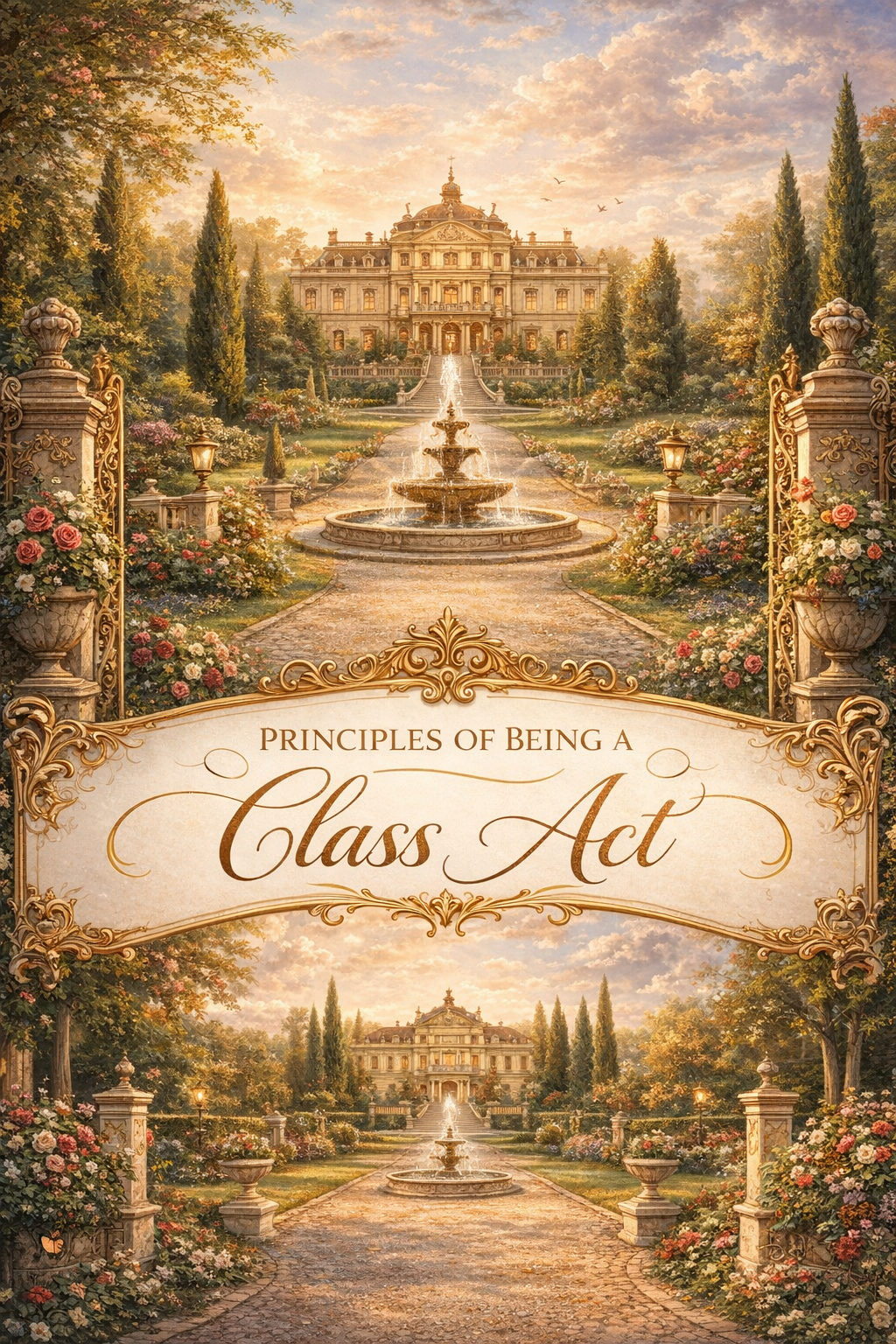
Entering the Estate: Awareness as the Gatekeeper
Imagine a vast estate, hidden in the folds of time, where the air is scented with the subtle fragrance of roses, cedarwood, and freshly polished wood. This estate is not ordinary—it is the estate of character, a space where every visitor brings the essence of who they are and is, in turn, shaped by it. To become a “class act” is not merely to walk through the gates of this estate—it is to become part of its architecture, its gardens, its fountains, and its invisible laws.
Entering the estate begins with awareness. Awareness is the gatekeeper, the silent guardian who observes how you carry yourself before you even speak. You may approach the gates adorned in the finest attire, yet without awareness, the gatekeeper will see the tension in your shoulders, the haste in your step, the impatience in your gaze. To those seeking to embody class, the lesson is clear: presence is not an accessory—it is a foundation. Every action, every word, and every thought must align with the invisible standards of elegance and integrity that govern this inner realm.
Walking the Gardens: Cultivating Inner Traits
Once inside, the gardens unfold—immense, meticulously curated spaces where nature and nurture meet. Each flower represents a trait: humility blooms alongside courage; patience intertwines with wit; generosity grows beside discernment. A class act walks these gardens daily, tending to these traits as if they were delicate roses. This tending is neither showy nor boastful; it is an intimate, almost sacred engagement with one’s inner landscape. You prune arrogance like a wild vine, water empathy like parched earth, and ensure that your intellect flourishes without overtaking the delicate blooms of kindness and grace.
The Marble Halls: Speaking with Purpose
In this estate, silence is as valuable as conversation. The marble halls echo with the wisdom of those who understood that restraint is not weakness but mastery. Here, speaking requires precision and purpose. A class act does not fill the air with empty words. Every utterance is deliberate, measured, and attuned to the space and the people around them. Like a pianist who knows when to let a note linger, the class act understands that timing and tone are as essential as content. Words, after all, are instruments—how they resonate defines the harmony or discord they create.
The Dining Hall: Etiquette as Social Intelligence
The dining hall of the estate teaches lessons of both taste and behavior. Imagine a long table, set with crystal glasses and silver cutlery, where each place is arranged not for show but for comfort and order. Dining is not only about nourishment—it is a practice of manners, consideration, and attentiveness. The class act does not rush, does not gesture carelessly, and does not monopolize attention. They listen as intently as they eat, appreciating the textures of conversation as they would savor the textures of fine food. Here, etiquette is not a set of arbitrary rules but a dance of awareness and respect, a choreography of social intelligence.
The Library: Knowledge for Connection
Beyond the gardens and halls lies the estate’s library—a vast repository of human experience, wisdom, and imagination. To become a class act, one must walk its corridors often, drinking deeply from the stories and knowledge that lie within. This is not for mere accumulation of facts, but for the cultivation of discernment. A class act can reference history, literature, and art not to flaunt learning but to illuminate understanding. Their knowledge serves connection, empathy, and perspective. They are aware that ignorance, when hidden by arrogance, diminishes character, while humility coupled with curiosity elevates it.
Storms and Trials: Grace Under Pressure
The estate is not without its trials. A storm may rage across the grounds, shaking trees, flooding gardens, and testing the foundation of every building. In these storms, the measure of a class act becomes evident. Grace under pressure is not born from luck but from preparation and self-mastery. The tempest does not invite panic or dramatics; it calls for steady hands, calm minds, and resilient hearts. The class act moves with poise, neither fleeing nor lashing out, but addressing what is within their control while maintaining the dignity that defines them. Their reactions become lessons for others, quiet demonstrations that adversity need not compromise elegance or integrity.
The Mirror: Reflection and Truth
In one corner of the estate stands a mirror, framed with gold and etched with subtle reminders of reflection and truth. This mirror does not lie. It shows not only appearance but essence—the alignment of values, behavior, and presence. The class act gazes into this mirror daily, asking not “What do others see?” but “Does this reflect who I am striving to be?” They are honest with themselves about their shortcomings, neither indulging in self-criticism nor excusing failings. Reflection is the water that nourishes the gardens within, a source of clarity that ensures every step is intentional, every gesture meaningful.
Crossing the Bridge: Courage and Growth
The estate also includes a vast bridge spanning a serene river. On one side lies the comfort of familiarity; on the other, the unknown world of growth, challenge, and new experience. Crossing this bridge is symbolic of every decision a class act makes to expand themselves. Fear of judgment, comfort with the ordinary, and laziness in character are the currents below, attempting to pull one back. Yet the class act walks steadily, knowing that true refinement comes from the courage to engage with the unfamiliar with curiosity and respect. Each step on the bridge builds confidence, resilience, and sophistication—the invisible scaffolding of a class act.
The Music Chamber: Harmonizing with Others
Among the estate’s many rooms is a music chamber, resonant with instruments waiting to be played. Here, metaphor meets action. The class act learns to harmonize with others, not dominate. Leadership, when necessary, is not coercion; it is the art of guiding without overshadowing. Influence is not earned through volume or force but through consistency, empathy, and reliability. In this chamber, collaboration becomes symphony, every note respectful of the others, every silence purposeful. The class act understands that social grace is a melody woven from respect, discernment, and timing.
Hidden Paths: Subtlety and Discretion
Another lesson lies in the estate’s hidden paths—narrow, winding trails shaded by ancient trees. These paths teach subtlety, discretion, and patience. Not every truth or feeling must be broadcast; some are best expressed with nuance or held quietly in the heart. The class act recognizes that power often lies in restraint. They navigate social landscapes like these paths, choosing when to reveal, when to observe, and when to wait. Impulsivity and spectacle are avoided, replaced by careful attention and the quiet confidence that comes from knowing one’s intentions and boundaries.
The Stables: Empathy and Leadership
The estate’s stables, where horses of varied temperament are kept, offer lessons in empathy and leadership. A class act interacts with others, human or otherwise, with patience and understanding. They adjust their approach to the temperament before them, offering firmness or gentleness as needed. This teaches that authority is not dominance but influence, that respect is earned through fairness and consistency, and that every being—regardless of station—deserves acknowledgment and consideration. A class act is aware that true presence is a blend of strength and sensitivity, of decisiveness and compassion.
Nightfall and the Torches: Integrity in Darkness
As night falls on the estate, torches are lit along the walkways, casting a warm, steady glow. Darkness, like challenge and uncertainty, can reveal character in unexpected ways. The class act moves through these shadows with calm assurance, guided by internal light rather than external spectacle. They understand that dignity is most evident not in the spotlight but in quiet moments, when observation is limited, and choices are authentic. Integrity is the torch they carry, illuminating not only their path but offering guidance for others navigating the same grounds.
Invisible Walls: Boundaries and Respect
Perhaps the most essential feature of the estate is its invisible walls—the intangible boundaries that protect the integrity of the space. A class act knows that their presence and actions create their own boundaries, that they are responsible for maintaining them without hostility or defensiveness. Respect for oneself and for others is non-negotiable; it is silently communicated through behavior, posture, and the cadence of speech. Crossing these invisible walls without invitation or care disrupts the harmony of the estate, and the class act avoids this through mindfulness, patience, and moral clarity.
The Fountains: Generosity and Grace
In the estate’s courtyard, fountains shimmer in the sunlight, each drop a metaphor for generosity and grace. A class act gives freely, but not indiscriminately. Their generosity is thoughtful, meaningful, and sustainable. They recognize that giving without discernment can dilute value, while giving with awareness enhances both the giver and the receiver. They understand that a true class act creates abundance, not show, and that their influence is magnified when rooted in sincerity and awareness.
The Continuous Journey: Life as Practice
The journey through this metaphorical estate is not linear. Paths intersect, gardens overlap, and lessons recur in different forms. Becoming a class act is not a destination—it is a continuous practice, a lifelong cultivation of character, presence, and integrity. It is learning to move through the world with elegance not for recognition but because such a way of being is aligned with one’s highest self. It is embodying the harmony of intellect, empathy, courage, and restraint so that each action, word, and thought resonates with authenticity and grace.
Leaving a Lasting Impression: Quiet Influence
Finally, to become a class act is to leave the estate in a state of quiet influence. Others may not always name the lessons or observe the meticulous cultivation, yet they feel it in the aura, the energy, and the ease that surrounds the person. A class act is remembered not for flamboyance but for consistency, not for loud declarations but for subtle impact, not for fleeting charm but for enduring resonance. Their presence is a gift, their behavior a model, and their integrity an unspoken promise: that dignity, awareness, and grace are achievable, cultivated, and sustainable in a world that often forgets them.
Conclusion: Harmonizing Internal and External
In the end, the metaphorical estate is both the teacher and the reflection of the self. Those who traverse its halls, tend its gardens, and navigate its paths emerge not as perfect beings but as individuals whose presence is calibrated with care, whose actions are deliberate, and whose character radiates subtle, unshakable strength. They are class acts—not because the world labels them so, but because they have harmonized the internal and external, the seen and unseen, the immediate and enduring. They embody a quiet mastery that, like the estate itself, stands timeless and inviting, offering lessons to any who are willing to enter with curiosity, humility, and intention.