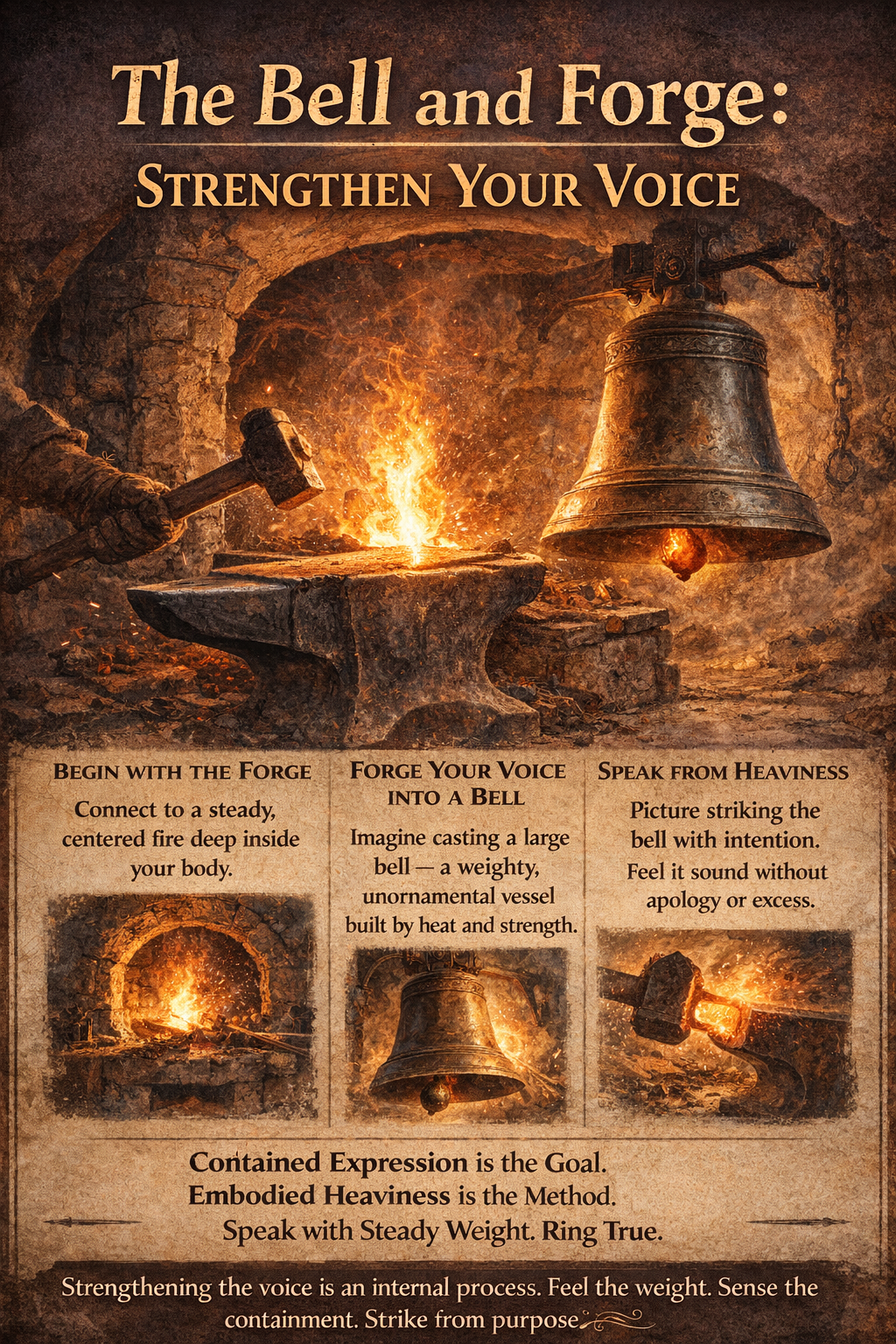
This guided mindfulness visualization is intended for readers who experience tension, hesitation, or internal fragmentation around self-expression. It is especially suited to people who have learned—often early in life—to monitor, adapt, or contain themselves in order to preserve connection, safety, or belonging. Over time, that adaptation can produce a familiar pattern: either the voice does not come out at all, or it comes out with more force than intended.
“The Bell and the Forge” is not a practice of emotional release or catharsis. It is a practice of containment. Where many contemplative exercises emphasize dissolving, softening, or letting go, this visualization emphasizes structure, weight, and deliberate action. The aim is not to feel better in the moment, but to develop a stable internal relationship to one’s own voice—so that expression can be clear, proportionate, and grounded.
This piece can be read silently, used as a slow self-guided meditation, or adapted for audio. It is written to work through imagery rather than instruction, allowing meaning to land somatically rather than cognitively. Readers may find that the imagery deepens with repetition. There is no need to rush the process or “get it right.”
If strong emotion arises at any point, return attention to the physical body: the breath, the feet, the contact with the ground. The purpose of this visualization is not to overwhelm the nervous system, but to strengthen the felt sense of internal solidity from which true speech becomes possible.
Arrival and Grounding
Begin by settling into your body. Do not try to relax or improve anything. Simply allow yourself to arrive where you already are, noticing the state you are in without judgment or correction.
Bring awareness to your feet on the floor. Notice the contact points: heel, arch, toes. Sense the ground supporting you. Let some of your weight be received by what is beneath you rather than held entirely by effort.
Notice the weight of your body being supported—by the chair, the floor, or the surface you are on. There is nothing you need to accomplish in this moment. No role to perform. No impression to manage.
Gently bring your attention to your breath. Do not attempt to slow it or deepen it. Simply notice the inhale as it arrives and the exhale as it leaves. Let breathing happen on its own.
Thoughts will appear. Plans, memories, commentary, images. When they do, let them pass like weather moving across a wide sky. You do not need to chase them or push them away. Each time you notice attention drifting, return again to the simple sensation of breathing. This returning is not a mistake; it is the practice itself.
The Inner Forge
As attention settles more deeply into the body, imagine that deep inside your torso—below the chest and above the belly—there is a forge. An old forge, made of stone, darkened by time and use. Not sleek or modern. Solid, thick, and built to endure.
This forge has always been there. It existed when you were confident, and it existed when you were quiet. It remained when you adapted to others, when you swallowed words, when you learned to read the room instead of speak into it. The forge did not disappear during those times. It waited.
Inside the forge is heat. Not chaotic or explosive heat, but steady, contained, and purposeful. This heat is your life force—your vitality, your capacity to care, your right to exist as you are. Not your productivity. Not your usefulness. Not your ability to be agreeable or pleasing. Simply your being.
Take a moment to notice the forge more fully. Its size and thickness. Its weight. Its patience. Notice how it does not rush or seek approval. It does not justify itself. It has outlasted many periods of doubt and self-silencing.
The Bell of Voice
Now imagine that from this forge, something has been made. A bell. Large and heavy, cast deliberately rather than ornamentally. Thick-walled, practical, and functional. This bell was not created to be decorative or constantly ringing. It was made to last.
The bell represents your voice. Not your explanations, not your justifications, not the anxious commentary that often follows speech. Your voice itself. The part of you that can state truth cleanly without excess.
Notice that this bell does not ring all the time. It is not noisy or attention-seeking. It does not interrupt. It rings only when struck with intention. And because of that, when it does ring, it carries weight.
Breath as Regulator
Return briefly to your breath. With each inhale, imagine drawing warmth from the forge—strengthening but not burning. With each exhale, imagine the bell settling more firmly, grounded and steady.
The Single Strike
Now imagine that you are holding the striker. It has weight. It is not something you swing casually. To lift it requires a choice. You do not test the sound. You do not tap nervously. You strike once.
When the bell sounds, the air moves. Not violently and not aggressively, but undeniably. The space responds. The ground subtly registers the vibration. The sound does not ask permission or negotiate. It simply announces presence.
Notice the quality of the tone. Low, clear, resonant. It does not shout or plead. It is unavoidable because it is proportionate and true.
Speaking in Relationship
Now bring to mind a relationship in your life. Choose a real one rather than the most dramatic. Picture the other person in front of you. Notice your posture in this image. You are not bracing, shrinking, or leaning forward to manage their reaction. You are standing beside the bell, not inside it.
This distinction matters. You are not fused with your voice. You are not becoming it. You are the one who decides when it sounds.
When you strike the bell in this image, you are not trying to control the other person’s response. You are not persuading, defending, or performing. You are simply allowing truth to sound.
Silently offer a sentence into the bell. Something brief and clean. Something final in its clarity. “This is not okay for me.” Or, “I need this.” Or, “I won’t move past this.” Or, “This stops here.”
Let the bell ring fully. Do not rush to soften it or follow it with explanations. Do not chase the echo. If fear arises, notice it without trying to remove it. Fear does not mean you are wrong. It means something real is happening. Fear and power are not opposites; they can coexist.
If the other person reacts in your imagination, allow it. They may push back, withdraw, escalate, or go quiet. The bell’s job is not to convince or regulate them. It is not responsible for the outcome. Its only job is to ring true.
After the Sound
Now allow the sound to fade naturally. Notice that nothing collapses as it fades. The bell remains. The forge remains. Your body remains. Your breath remains.
Bring attention back to your breathing. Notice the inhale and the exhale. Feel your feet on the floor again, the steadiness of your legs, the length of your spine, the weight of your body being supported.
Integration
When you are ready, gently open your eyes. Carry this knowing with you: your voice is not fragile. It is forged. And when it sounds, it changes the space—not because it is loud, but because it is real.