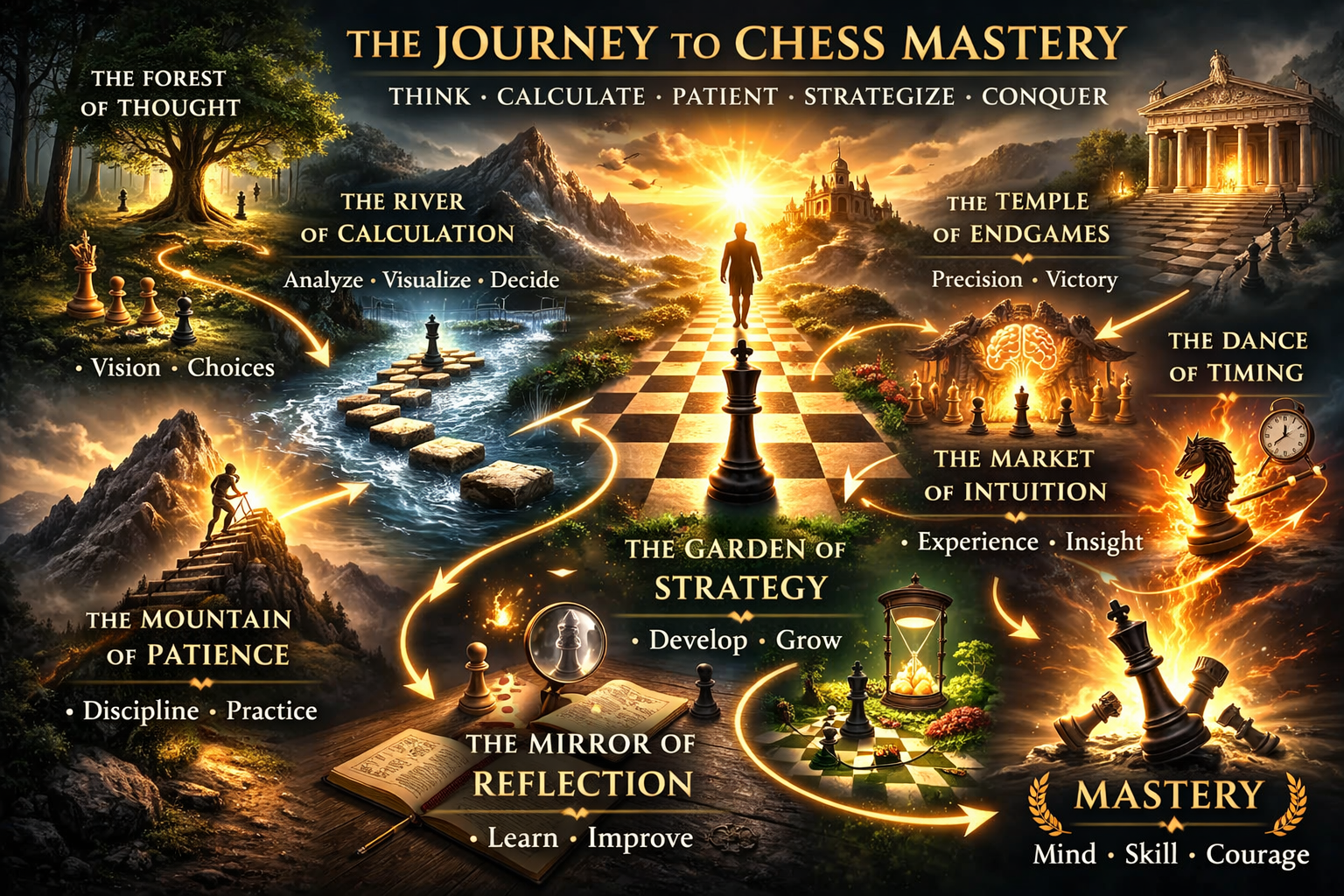
The Forest of the Mind
Imagine your mind as a vast, dense forest. Each tree is a thought, each clearing a potential move, each winding path a strategy. When you first enter, it is overwhelming—every path looks promising, every tree hides its secrets, and the shadows obscure what lies ahead. This is the beginning of learning chess: the forest is unfamiliar, and your first instincts are reactive, moving from branch to branch without understanding which path will lead to sunlight and which will lead to thorns.
To navigate the forest, you need more than sight—you need patience. Move slowly, notice the patterns of light and shadow, feel the subtle shifts in the wind. Each piece on the chessboard is a creature in the forest. The pawn is a cautious rabbit, timid but resilient, able to traverse paths no other can. The knight is a fox, clever and unpredictable, able to leap over obstacles that trap the less nimble. The bishop is a hawk, cutting diagonally through space, seeing far but limited to its own angle of approach. The rook is an elephant, powerful and unwavering, moving with authority along straight avenues. The queen is the storm, capable of shaping the forest itself, and the king is the ancient oak, whose survival is the ultimate goal, fragile yet central.
The River of Calculation
Deep in the forest runs a river. The water represents calculation. Some see the river and jump in recklessly, splashing and causing waves that cloud judgment. Others stand at the edge, testing the current, observing how the water twists around rocks, how it changes speed and depth. To become a master of chess, you must learn to read the river.
Look at the stones beneath the water’s surface: each is a possibility, each can either support your crossing or trip you into the current. Sometimes, the river is calm—allowing you to see far ahead. Other times, it is turbulent, and your eyes can only catch glimpses. Recognize that you cannot control the water, but you can control how you step. Every decision in chess is like stepping from stone to stone. Step too quickly, and you slip; hesitate too long, and the water carries your opportunity away.
In this river, imagination flows like eddies and whirlpools. You must visualize moves that do not yet exist, possibilities that may never materialize. See the future board as clearly as you see the reflection of trees on the surface. Practice this, and soon your mind will dance along the river, feeling currents before they reach your eyes, sensing the optimal path before it appears.
The Mountain of Patience
Beyond the river rises a mountain. It is steep, covered with loose rocks and thorny underbrush. Climbing this mountain represents the discipline required to improve: the hours of practice, the repetition of patterns, the long study of openings, middle games, and endgames.
At first, the climb seems endless. You may see other climbers ahead, moving faster, appearing to have mastered the ascent. Resist envy. Each step you take, however small, is a step in your personal growth. The mountain teaches a vital truth: the greatest progress in chess comes not from speed but from deliberate, consistent effort.
Sometimes, the wind is harsh, representing distraction or mental fatigue. You may feel like slipping, like giving up. Here, you must anchor yourself to your principles. Remember that every small advance—every pawn pushed, every piece developed—is a foothold, stabilizing your ascent. Over time, the mountain changes your perspective. From the peak, the forest below appears organized, patterns emerge, and what once seemed chaotic now makes sense.
The Market of Intuition
In the valley below, there is a bustling market. Here lies intuition—the unspoken understanding of the game. The market is noisy: hawkers call out their goods, bartering occurs in whispers and shouts, and you must learn to discern the subtle cues. In chess, intuition is cultivated by experience. The first time you enter the market, every sound is overwhelming; you cannot yet separate gold from straw.
You wander slowly, tasting, listening, feeling. Eventually, you notice that some stalls consistently provide high-quality goods. You begin to trust your instincts about where to look, whom to follow, which pathways are shortcuts and which are traps. In the same way, you begin to sense which moves feel “right” on the board without calculating every single line. Intuition is the product of familiarity, pattern recognition, and the ability to integrate past experience into present choices.
The Chess Garden
Imagine a quiet garden where every piece has its own flowerbed. Pawns are rows of lavender, modest yet fragrant. Knights are winding vines, unpredictable and curling in unexpected ways. Bishops are tall sunflowers, swaying in the wind with diagonal elegance. Rooks are hedges, strong and straight. The queen is a blooming rose, radiant and dominating the garden, while the king is a solitary oak, protected but essential.
Tend your garden daily. Study each flowerbed, understand its strengths and limitations. Sometimes, pests appear—opponent’s moves that threaten your balance. Respond with care, pruning where necessary, supporting weaker plants, and allowing your stronger ones to flourish. The chessboard, like the garden, is alive. Your moves are acts of cultivation, and every game is a season of growth.
The Dance of Timing
Chess is a dance. Each piece moves with a rhythm that must harmonize with the others. Push a pawn too early, and you break the tempo; develop a knight too late, and your formation falters. The best players are dancers—they know when to advance, when to retreat, when to feint.
Imagine a ballroom filled with shadows of pieces. You feel the timing in your bones before your eyes register it. You sway with the board, anticipating the opponent’s steps, creating opportunities in the spaces between movements. Every sacrifice, every pawn push, every defensive maneuver is a beat in the choreography. Practice this dance in solitude, moving your pieces as if your hands are limbs of a practiced dancer, until your body begins to recognize the cadence without conscious thought.
The Mirror of Reflection
After each game, enter a chamber with a mirror. Here, reflection is key. Observe your moves, your successes, your failures. Do not shy away from mistakes—they are not marks of shame but gateways to insight.
Look into the mirror of reflection and ask: where did I misjudge? Where did I hesitate? Which moves were impulsive, which were deliberate? The mirror is unflinching. It shows not only your errors but also your blind spots: recurring patterns where you allow fear, impatience, or arrogance to dictate your choices. By confronting these honestly, you sharpen your perception, align your mind with purpose, and prepare to enter the forest once more with greater clarity.
The Temple of Endgames
At the summit of the mountain lies a quiet temple. Here, the endgame is studied. The temple is serene but unforgiving. Pawns, knights, rooks, and the kings of games long past are etched into the walls. They whisper secrets of precision, the subtle art of converting small advantages, the patience required when the board is sparse.
Many players fear the temple, preferring the chaos of the middle game. Yet the temple holds the deepest truths: understanding the endgame transforms how you approach every move. Like monks in meditation, study the temple with reverence. Learn the power of opposition, triangulation, and zugzwang. The wisdom here carries forward into every forest, every river, every market you traverse.
The Orchestra of Strategy
Chess is not just calculation or tactics—it is strategy, the orchestration of all forces in harmony. Imagine an orchestra: pawns are the percussion, providing rhythm and structure; knights and bishops are the strings, weaving complexity and nuance; rooks are brass, imposing and commanding; the queen is the conductor, capable of unifying and directing every motion; and the king is the audience, whose survival guides the performance.
A game is a symphony of choices, where each move resonates with future possibilities. To play well, listen. Hear the interplay between pieces, feel the tension in open files, anticipate crescendos and decrescendos. With practice, your mind begins to conduct without hesitation, blending calculation, intuition, timing, and vision into a coherent whole.
The Journey of Mastery
Chess mastery is not a destination—it is a journey through forests, rivers, mountains, markets, gardens, dances, mirrors, temples, and orchestras. Each experience teaches a new dimension of perception: how to calculate, how to anticipate, how to remain patient, how to cultivate intuition, how to recognize timing, how to reflect, and how to strategize.
Every game you play, every position you study, every loss you analyze is a step along this path. There is no shortcut to mastery, only dedication and mindful practice. Over time, the forest becomes familiar, the river navigable, the mountain climb steady, the market clear, the garden thriving, the dance effortless, the mirror honest, the temple understood, and the orchestra harmonious.
As your journey continues, remember that chess is more than a game. It is a mirror of the mind, a reflection of discipline, creativity, patience, and courage. Every challenge on the board is a metaphor for life itself: plan carefully, act decisively, anticipate wisely, and learn constantly. Those who embrace the journey with humility, focus, and passion eventually move beyond mere competence, achieving not only mastery of the game but mastery of themselves.