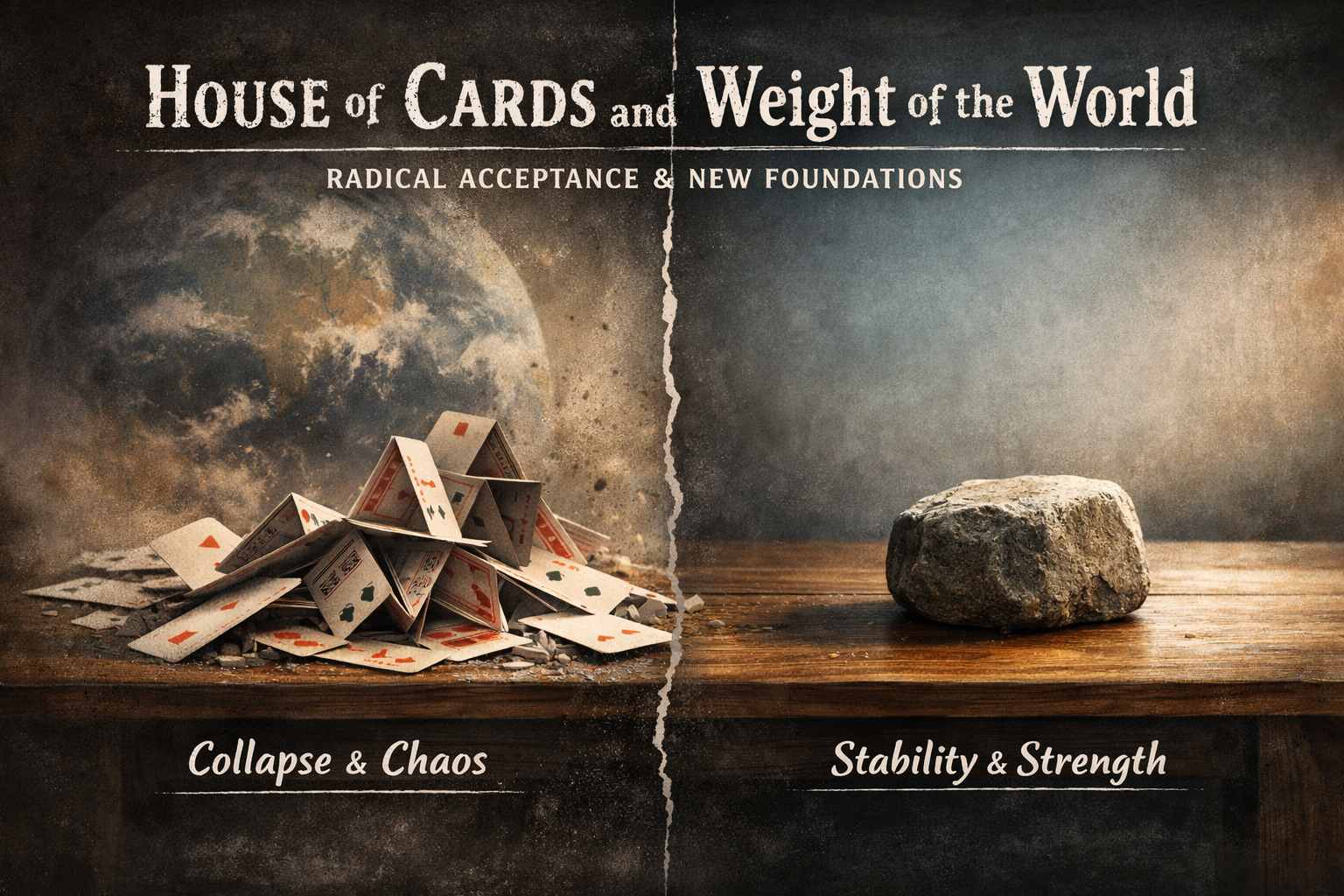
A Metaphorical Exercise in Radically Accepting Structural Mistakes and Beginning Again
This is a personal growth exercise to rebuild your life. Read this slowly and let the images build at their own pace. Don’t analyze your life while reading. Just observe what forms in your mind. This is about seeing structure clearly, not judging yourself.
The First Card
Imagine a quiet room with a heavy wooden table in the center. The air is still, almost dense. On the table lies a single playing card, flat against the surface. It looks harmless on its own, almost insignificant.
This card represents a meaningful decision from your past. A choice made under pressure, emotion, ambition, fear, desire, or urgency. At the time, it felt workable. It may even have felt necessary.
But a single card lying flat does not create a structure. It is merely the crucial precursor to one.
The Inverted V
Soon after that first decision, another important choice was made. Not random. Not trivial. A choice designed — consciously or not — to protect the first one. Now you have two cards. You place the two cards leaning against each other, forming an inverted V.
Now something stands.
Life continues and consequences ripple outward. The first compensation requires reinforcement. Two more decisions are made — perhaps a career move made solely to justify the direction, perhaps a relationship chosen only to stabilize emotion, perhaps a powerless silence to prevent exposure.
Two more cards form another inverted V beside the first. The structure begins to look intentional.
Reinforcement and Architecture
A new layer follows. A horizontal card is laid carefully across the two inverted Vs, binding them together. This larger decision connects the compensations and gives the appearance of unity. From the outside, it starts to resemble architecture rather than reaction.
More inverted Vs are added. More horizontal connectors. Financial commitments that lock you in. Identities that maintain coherence. Narratives that explain everything convincingly. The house begins to rise.
Each new card is placed not because it is the cleanest truth, but because it supports the house of cards that is already standing.
The house grows taller and more intricate. It becomes clever. Even impressive. You learn how to distribute weight across weak points and reinforce subtle instabilities.
You become highly skilled and intensely focused at protecting the structure.
The Burdensome Cost of Maintenance
Notice what this requires.
Constant attention. Emotional vigilance. Careful language. Avoidance of certain conversations. Anticipation of shifts before they occur. A low hum in your nervous system that never quite turns off.
You call it responsibility. You call it maturity. You call it complexity.
Underneath, it is maintenance.
Years pass and the house stands tall. Entire seasons of your life are embedded within it. The first card is buried deep inside the structure, almost invisible and forgotten now.
Yet everything else still depends on it.
The Inevitable Collapse Through Gravity
Then something changes in the room. The air grows heavier. The light feels denser. A presence enters — not dramatic, not emotional, not here to accuse.
It’s gravity.
Gravity, in this metaphorical sense, carries a Saturnian edge. It’s how time combines with consequence. It marks the end of postponement. As the task master, it does not argue about intention—it simply places a heavy load, testing the integrity of your foundational life structure. When active, gravity increases weight and causes all unstable, unworthy structures to collapse.
Under the conditions of ordinary gravity, your house of cards could stand as long as you remained vigilant. Under this increased gravity, vigilance is no longer enough. The structure must hold on its own — or it will not hold at all.
You feel the impulse to once again reinforce a weak section. To add another compensatory card. To explain better, work harder, stabilize more carefully. But this time, you see the pattern clearly. Every additional card deepens your powerless dependence on the original tilt.
Letting Go of Control
So you remove your hands. You stop stabilizing. You stop justifying. You stop optimizing around what should have been corrected long ago. You allow gravity to act without interference.
At first, there is stillness. Then, a subtle shift in one inverted V. The horizontal card above it slides slightly. That movement transfers pressure across the structure. Another V trembles. Then the cascade begins.
Precise. Quiet. Inevitable. One support collapses into another, and the horizontal connectors slip free. Upper layers fold downward in a controlled surrender to gravity. For a brief moment, the buried first card is exposed — and then it too disappears into the flattening.
Within moments, the entire house lies scattered across the table. All the compensations. All the strategic brilliance. All the careful balancing that once felt necessary and intelligent.
Gone.
Taking Ownership
Stand there and look at it without rushing to clean it up. Feel what rises in you — grief for the time invested, embarrassment at the fragility, anger at yourself for sustaining it longer than needed, and perhaps a quiet relief that you no longer have to hold it upright.
Walk to the table and kneel beside the fallen cards. Place your hand on them and say quietly, without excuse and without self-hatred, “I built this.”
Let the sentence land fully in your body before you move on.
This is not punishment. It is power returning to you. You made the first decision. You built the inverted Vs that protected it. You laid the horizontal reinforcements and maintained the structure for years.
And under your radical acceptance combined with the weight of the world, it finally collapsed.
Recognizing the Stone of Stability
Look at the table again with steady eyes. It is clear except for scattered cards that no longer demand vigilance. There is no trembling architecture requiring breath control or constant correction. There is only a solid surface beneath unarguable gravity.
Beside the deck of cards, notice something you did not see before. A stone rests near the edge of the table, dense and unpolished. It has been there the entire time, waiting for you to notice it.
You pick up the stone and feel its weight in your hand. It does not bend or lean. It does not depend on another stone to remain upright. It carries its own mass without apology.
You place the stone in the center of the table and remove your hand. It does not wobble. There is no inverted V beneath it. No hidden tilt. No invisible strain that must be managed in the background.
This stone represents a decision made in alignment with reality as it exists now. It does not defend the past or attempt to justify the first card. It does not optimize around an old mistake or try to preserve a former image. It may be simple and even uncomfortable in its honesty. It may require letting go of status, identity, or expectation. But it does not require maintenance to remain standing.
This first stone begins to build your new foundation, stability, and alignment. Unlike cards, which represent compensations and fragile balancing acts, the stone is self-honest and allows all future decisions to rest safely, without seeking to bend reality or lean on the past.
Building Your Structure of Stone
With this stone and others you acquire through such right action, you can build many things, depending on what your life requires. You might:
- Stack more stones — create a tower of integrity, each decision self-honest, self-contained, and durable.
- Construct a wall — a healthy boundary or framework that protects what is essential and keeps distractions and instability at bay.
- Form a pathway — lay stepping stones, each aligned with intention, allowing you to move forward steadily toward long-term goals.
- Create a platform — a base for growth, creativity, relationships or projects that can bear weight without collapsing.
- Craft a cairn (a stacked stone marker) — noting lessons learned, a visible testament to accountability and experience
Stand in the quiet room a moment longer and observe the contrast. Scattered cards lie light and weightless across the surface. The stone rests steady, grounded, and unmoving.
You are no longer a person holding up a fragile structure with invisible effort. You are someone who understands gravity and no longer resists it. The weight that once threatened you now clarifies you. Gravity. once a nemesis, has now become a new friend.
Whatever you build next will be with stone. From this foundation, every choice you make is real, aligned, and capable of withstanding the weight of the world.